
Last updated July 10, 2026
Air Duct Cleaning Maintenance Checklist for Dayton Homeowners
The filter you changed last month doesn’t tell you anything about what’s accumulating inside the six inches of duct behind it. In our two decades of hands-on work across Dayton, we’ve opened supply plenums in Kettering homes that looked clean from the vent side but harbored three-inch mats of pet dander and construction debris from a 2019 remodel. Here’s what most homeowners miss: duct cleaning is a single intervention, not a maintenance strategy. This guide gives you the room-by-room checklist, seasonal timing, and visual inspection know-how to spot problems before they circulate through every room your family breathes in.
Quick Answer
Dayton homeowners should inspect visible registers monthly for dust buildup and airflow irregularities, change 1-inch pleated filters every 60–75 days during peak pollen season (March–June and August–October), and schedule professional duct cleaning with brush-and-vacuum equipment every 3–5 years—sooner if you notice musty odors, visible mold, or post-renovation debris. Between visits, maintain indoor humidity below 55% to prevent mold colonization in ductwork, particularly in Dayton’s muggy July–September stretch.
Table of Contents
- Why Maintenance Matters More Than the Cleaning Itself
- Room-by-Room Checklist: What to Watch at Every Register
- Dayton’s Filter Change Schedule: Ignore the Box
- How to Visually Inspect Accessible Ductwork Yourself
- Humidity Benchmarks That Prevent Mold in Dayton Ducts
- What You Handle vs. What Requires Professional Equipment
- Building Your Seasonal Maintenance Rhythm
- Common Mistakes to Avoid
- When to Call a Professional
- Frequently Asked Questions
- The Bottom Line
Why Maintenance Matters More Than the Cleaning Itself
We’ve cleaned ducts in Dayton’s South Park historic homes where the previous cleaning was eight years prior, and the accumulation wasn’t just dust—it was a layered sediment of fireplace soot, previous owners’ pet hair, and degraded fiberglass insulation particles. The cleaning restored airflow, but the years of neglect had already stressed the HVAC blower motor and embedded odors in porous duct liner.
The maintenance gap is where damage happens. Professional duct cleaning with Rotobrush or Nikro equipment removes what’s already built up. Maintenance prevents the next buildup from becoming a problem. Think of it as the difference between a dental deep-cleaning and daily flossing—both matter, but only one keeps the situation from recurring.
In Dayton specifically, our maintenance challenges cluster around four factors:
- Seasonal pollen density: The Miami Valley’s tree pollen season (March–May) and ragweed cycle (August–October) deposit allergenic particles that standard filters don’t fully capture.
- Humidity swings: Dayton’s average July humidity hits 72%, creating condensation conditions inside metal ductwork that static-pressure climates don’t face.
- Aging housing stock: Many Beavercreek and Oakwood homes run ductwork through unconditioned crawlspaces where temperature differentials accelerate debris aggregation.
- Post-industrial particulate: Older neighborhoods near former manufacturing sites still see elevated fine particulate that settles in low-velocity duct runs.
Your owner is your technician at Titan Air Duct Cleaning Greater Dayton home—Thomas Hernandez personally evaluates whether a home’s duct profile needs annual monitoring or can stretch to a five-year professional cycle.
Room-by-Room Checklist: What to Watch at Every Register
Most homeowners glance at a ceiling vent, see no obvious blockage, and move on. Here’s what we’ve learned in 20 years: the critical signals are subtle, and they’re different by room type. Print this section and walk your house quarterly.
Kitchen
- Remove the register and hold a flashlight at a sharp angle to the duct opening. Grease films from cooking aerosols create a sticky, yellow-brown coating that traps dust—this is normal but accelerates buildup. Wipe the first 6–8 inches with a damp microfiber cloth.
- Check for fruit fly or drain fly activity near the vent. These indicate moisture accumulation in the duct boot, often from a disconnected condensate line.
- Note any food odors when the system kicks on. This suggests a return-air leak pulling from wall cavities or the kitchen itself, bypassing filtration.
Bedrooms
- Run your hand 12 inches below the register with the blower on. Uneven airflow—strong on one side, weak on the other—signals a partial blockage or damper issue.
- Inspect for “ghosting”: dark streaks on the ceiling radiating from the vent. This indicates particulate filtration through the register gaps, meaning your filter is overloaded or poorly sealed.
- Check morning condensation on metal registers during Dayton’s shoulder seasons. Persistent moisture here invites mold in the duct boot.
Bathrooms
- Verify the exhaust fan duct hasn’t detached from the register housing—common in homes built 1985–2005. A detached duct dumps humid air into the ceiling cavity, not outside.
- Look for rust on metal register screws or surrounding drywall. Dayton’s hard water and humidity make this a leading indicator of chronic moisture.
- Confirm the bathroom exhaust runs independently, not tied into the HVAC return. This was a common shortcut in Huber Heights and Riverside construction of that era.
Basement and Utility Areas
- Inspect the main return-air grille. If you can see the filter behind it, the filter isn’t sealing properly—bypass air is unfiltered.
- Check the plenum (the large box where the furnace connects to ductwork) for tape degradation. Silver cloth tape older than 10 years often fails; foil tape lasts longer but still needs inspection.
- Look for rodent evidence: droppings, chewed insulation, or nesting material at duct seams. Dayton’s field mice seek winter shelter in basement ductwork.
Living Areas
- Move furniture and check floor registers for toy fragments, pet hair accumulation, and—surprisingly often—lost items blocking 30% of airflow.
- Test register louvers for free movement. Stiff or painted-shut louvers prevent proper air direction, creating stagnant zones where dust settles.
- Note dust resettlement within 48 hours of cleaning. Rapid reaccumulation indicates duct-source contamination, not normal household dust.
Dayton’s Filter Change Schedule: Ignore the Box
Filter packaging claims “up to 90 days” based on idealized laboratory conditions. In Dayton, those conditions don’t exist for six months of the year.
Here’s our field-tested schedule for 1-inch pleated filters in the Miami Valley:
| Timeframe | Filter Change Interval | Why Dayton Differs |
|---|---|---|
| March–June | Every 45–60 days | Tree pollen peak; oak, maple, and birch release simultaneously. We’ve extracted filters in Centerville homes that were 80% occluded at 50 days. |
| July–August | Every 60–75 days | Higher humidity loads the filter with moisture, reducing effective pore size faster. Check for filter sagging or microbial spotting. |
| September–October | Every 50–60 days | Ragweed and mold spores peak. Dayton’s river valleys trap agricultural dust from harvest activity. |
| November–February | Every 75–90 days | Lowest particulate load, but verify no bypass from holiday cooking and increased occupancy. |
For 4–5 inch media filters (Honeywell, Aprilaire), extend intervals by 50%—but verify the cabinet seal annually. We’ve found improperly seated media filters in Moraine homes that bypassed 40% of airflow unfiltered for months.
Never run a filter past visible gray discoloration. The pressure drop across a loaded filter forces your blower motor to work harder and can pull unfiltered air through gaps in the filter rack.
How to Visually Inspect Accessible Ductwork Yourself
You won’t see deep into the system without professional equipment, but accessible sections reveal plenty. Here’s what’s safe to check and what findings mean.
What You Can Safely Access
- Register openings (first 12–18 inches of duct)
- Basement supply and return trunks (the large rectangular ducts)
- Plenum exterior and filter rack
- Exposed flex duct in unfinished basements or attics
- Dryer vent termination hood (exterior)
Step-by-Step Inspection Protocol
- Photograph before you touch anything. Documentation helps track changes over time and gives any technician you call a baseline.
- Use a borescope or inspection camera. Consumer models ($30–$80) with 6-foot cables reach past the first duct elbow. Look for standing debris, moisture sheen, or irregular surface texture indicating biofilm growth.
- Check flex duct for sagging. Flex duct should maintain gentle curves; dips create low-velocity zones where debris settles. In Dayton’s older ranch homes, we’ve found flex duct in attics that sagged 4–6 inches from improper support spacing.
- Inspect metal trunk seams for tape failure. Gaps at seams pull attic or crawlspace air into the system—unfiltered, often humid, sometimes carrying insulation particles.
- Look for condensation staining on duct exterior. Cold duct surfaces in humid crawlspaces sweat; sustained wetting degrades duct liner and supports mold. This is particularly common in Washington Township homes with dirt-floored crawlspaces.
When to Call vs. Wait
| Finding | Action |
|---|---|
| Light dust coating, less than 1/8 inch | Monitor; schedule routine cleaning |
| Greasy or sticky residue | Schedule cleaning within 60 days; source likely kitchen or smoking |
| Visible mold growth (any color) | Call immediately; do not disturb—spore release worsens contamination |
| Standing water or moisture | Call immediately; indicates drainage or humidity control failure |
| Debris more than 1/4 inch deep | Schedule cleaning; airflow restriction is likely |
| Insulation degradation or rodent evidence | Call for duct repair assessment; cleaning alone won’t fix |
Humidity Benchmarks That Prevent Mold in Dayton Ducts
Mold in ductwork doesn’t require flooding. It requires sustained relative humidity above 60% on a surface that provides organic material—and dust is organic enough. Dayton’s climate delivers these conditions predictably.
Our 20-year dataset from jobs across Montgomery County shows mold-positive duct inspections cluster when:
- Indoor RH exceeds 55% for more than 48 consecutive hours
- Crawlspace RH exceeds 70% (ducts in these spaces act as condensation radiators)
- Air conditioning supply temperature is more than 20°F below return-air dewpoint
The July–September window is critical. Dayton’s average outdoor dewpoint in July is 65°F; with a properly sized AC system delivering 55°F supply air, your duct surfaces may reach the dewpoint during off-cycle periods. Undersized systems that run continuously avoid this, but oversized systems—common in older Dayton homes with recent high-efficiency furnace upgrades—cycle off and allow surface wetting.
Practical targets for Dayton homeowners:
| Location | Target RH | Monitoring Tool |
|---|---|---|
| Living spaces | 45–50% | Hygrometer ($15–$30); check monthly |
| Basement | 50–55% | Dehumidifier with built-in humidistat; Aprilaire or Honeywell whole-house units integrate with HVAC |
| Crawlspace | Below 65% | Vapor barrier plus dedicated dehumidification if dirt-floored |
We’ve installed Aprilaire whole-house dehumidifiers in Englewood and Vandalia homes where duct mold recurred despite cleaning—the humidity source, not the duct, was the root cause. Air Duct Cleaning in Dayton addresses the symptom; humidity control prevents recurrence.
What You Handle vs. What Requires Professional Equipment
This boundary frustrates homeowners who want to self-manage. Here’s the honest breakdown from someone who’s both cleaned ducts and explained limits to customers for two decades.
Homeowner Domain
- Filter changes and register cleaning
- Visual inspection of accessible sections
- Humidity monitoring and dehumidifier operation
- Register louver adjustment for airflow balance
- Exterior dryer vent hood cleaning (lint removal from accessible areas)
- Furniture and vent clearance management
Professional-Only Territory
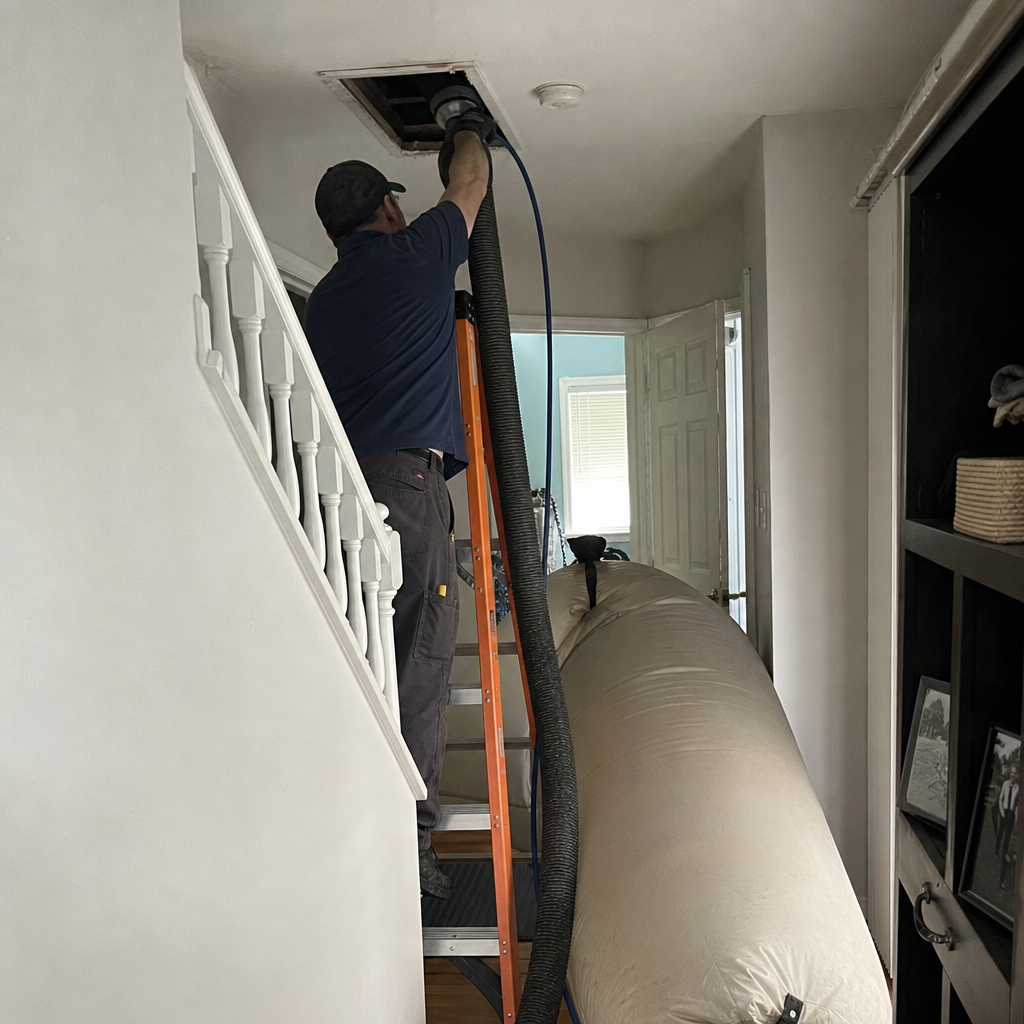
- Mechanical agitation inside ductwork: Consumer vacuums lack the sealed suction and rotary brush systems (Rotobrush, Nikro) that dislodge adhered debris without damaging duct liner. We’ve repaired ductwork where homeowners used shop vacs with aggressive attachments.
- Negative-air containment: Proper duct cleaning isolates each branch to prevent cross-contamination. Without it, you’re redistributing debris room-to-room.
- Sanitizing application: EPA-registered products (Abatement Technologies, Guardsman formulations) require controlled application and dwell times. Over-application leaves residues; under-application fails efficacy.
- Duct repair and sealing: Mastic application, sleeve repair, and Aeroseal or equivalent sealing require training and pressurized verification.
- Mold remediation: Disturbing mold colonies without containment spreads spores. We use HEPA containment and negative air machines—equipment that doesn’t make sense for single-homeowner purchase.
The complete air pathway approach—cleaning, sanitizing, repair, sealing—is what separates specialist work from surface-level service. HVAC Cleaning in Dayton by Titan includes coil and blower cabinet cleaning that no homeowner can safely access without refrigerant line disruption risk.
Building Your Seasonal Maintenance Rhythm
Scatter these tasks across your calendar rather than attempting annual marathon sessions. Dayton’s climate gives you natural anchors.
March: Pre-Pollen Launch
- Change all filters; upgrade to MERV 11–13 if you’ve been running fiberglass
- Inspect and vacuum all registers
- Test dehumidifier operation before humidity season
- Schedule professional cleaning if it’s been 4+ years or you missed last year’s window
June: Mid-Season Check
- Replace filters (yes, again—pollen season is brutal)
- Check basement and crawlspace humidity readings
- Verify AC condensate drain is flowing freely; backup floods ductwork
- Inspect exterior dryer vent for lint accumulation—Dryer Vent Cleaning in Dayton is often overdue by this point
September: Post-Humidity Assessment
- Final filter change before heating season
- Visual inspection of accessible ductwork with borescope; photograph for comparison
- Check for musty odors when heat first cycles—summer moisture may have colonized
- Schedule any needed professional work before heating-season demand peaks
December: Heating-Season Baseline
- Monitor for dry-air symptoms (static, nosebleeds, woodwork gaps) that indicate over-drying or inadequate humidification
- Check that humidifier pad or drum is clean and functional—dirty humidifiers breed bacteria
- Verify no furniture has migrated to block registers during holiday rearrangement
Common Mistakes to Avoid
- Using the cheapest fiberglass filter. In Dayton’s pollen-dense environment, these capture less than 10% of fine particulate. The “savings” accelerate duct contamination and blower motor wear.
- Ignoring the return side. Homeowners obsess over supply vents (where air blows out) but the return grille pulls in unfiltered room air. A dirty return path contaminates the entire system upstream of the filter.
- Blocking vents for “efficiency.” Closing registers in unused rooms increases static pressure, forces duct leakage at seams, and can freeze AC coils. We’ve found collapsed flex duct in Centerville homes from this practice.
- DIY compressed air “cleaning.” Blowing compressed air into a register without containment launches debris into the living space and can damage duct liner. Professional systems use contained negative air for this reason.
- Waiting for visible dust at vents. By the time you see dust emission, the duct is heavily loaded. The goal is prevention, not reaction.
- Neglecting the dryer vent. A clogged dryer vent increases humidity load in the laundry area, strains the dryer, and creates fire risk. It’s part of the complete air pathway, not a separate concern.
- Assuming new construction is clean. We’ve cleaned post-construction ducts in Dayton’s developing townships where drywall dust, wood particles, and fastener debris created a half-inch layer. Build-grade filters don’t catch this.
When to Call a Professional
Call when you find mold, moisture, or debris beyond your reach. Call when airflow drops noticeably or odors persist after filter changes. Call after any renovation that generated dust, or when moving into a home with unknown maintenance history.
Specifically, contact a specialist when:
- Visual inspection reveals standing debris, moisture, or mold
- Multiple rooms show uneven heating or cooling despite register adjustment
- Energy bills spike without rate changes or weather explanation
- Family members experience unexplained respiratory symptoms that improve away from home
- It’s been 4+ years since professional cleaning, or never
Titan Air Duct Cleaning Greater Dayton offers free estimates in Dayton—call (866) 834-6947. Thomas Hernandez, your owner and lead technician, will assess your complete air pathway and recommend whether cleaning, repair, sealing, or humidity control is the right next step. Verified by 113 customers averaging 4.7 stars, our work speaks through results, not promises.
Frequently Asked Questions
Every 3–5 years for typical households, or every 2–3 years if you have pets, allergies, or live near high-particulate areas like Dayton’s industrial corridors or active construction zones. Homes with recent renovations should schedule within six months of project completion. Call (866) 834-6947 for a free estimate to determine your specific interval.
No—shop vacuums lack the sealed rotary brush systems and negative-air containment that prevent debris redistribution. Without mechanical agitation, you’re only removing loose surface dust, not the adhered buildup that restricts airflow. Worse, aggressive attachments can damage flex duct or dislodge connections. For safe, effective cleaning, professional-grade Rotobrush or Nikro equipment is required.
Rapid reaccumulation indicates either a duct-source leak pulling unfiltered air from attic or crawlspace, or a filter bypass issue. In Dayton’s older homes, we’ve found filter racks that don’t seal against the cabinet, allowing 20–30% unfiltered bypass. Check your filter fit first; if the problem persists, you need professional leak detection and sealing.
Yes—Dayton’s July average of 72% relative humidity creates condensation on cold duct surfaces, particularly in unconditioned spaces. Sustained surface wetting above 60% RH supports mold growth on dust films. We’ve remediated duct mold in Beavercreek and Oakwood homes where the root cause was crawlspace humidity, not duct contamination. Dehumidification is preventive maintenance, not optional comfort.
Repair is typically 30–50% of replacement cost for localized damage—disconnected boots, small holes, or failed tape seams. However, if your system uses asbestos-containing duct liner (common in pre-1985 Dayton homes), replacement with modern insulated duct is the only safe option. We assess repair viability during every cleaning and provide upfront pricing for either path. Call (866) 834-6947 for an exact quote—estimates are free.
Proper cleaning shows immediate, verifiable results: improved airflow at all registers (test with your hand), no dust emission during the first 48 hours of operation, and—if you inspect with a borescope—clean duct surfaces past the first elbow. The technician should provide before/after documentation and explain what was found. At Titan, Thomas Hernandez reviews findings with you personally before and after every job.
The Bottom Line
Duct maintenance is a rhythm, not an event. Dayton homeowners who inspect registers quarterly, change filters on a climate-adjusted schedule, monitor humidity against our 55% threshold, and schedule professional cleaning every 3–5 years with brush-and-vacuum equipment prevent the accumulated damage that makes ducts a health and efficiency liability. The filter you changed last month was step one; this checklist covers everything that comes after. Your owner is your technician at Titan Air Duct Cleaning Greater Dayton, and we’re here when your own inspection reveals what requires professional-grade intervention.
Written by Thomas Hernandez, Owner & Lead Technician at Titan Air Duct Cleaning Greater Dayton, serving Dayton since 2006.