
Last updated July 10, 2026
How to Hire a Air Duct Cleaning Contractor in Dayton: A Step-by-Step Guide
In Ohio, anyone with a van and a vacuum can legally call themselves an air duct cleaning contractor. That’s not a scare tactic — it’s the actual regulatory reality. There’s no state license specific to duct cleaning, no mandatory certification, and no inspector checking whether that $99 coupon crew actually knows how your HVAC system works. For Dayton homeowners, especially in older neighborhoods like Oakwood, Kettering, or the historic districts near downtown where duct systems vary dramatically by era, this means the vetting process falls entirely on you. This guide walks you through exactly how to separate a legitimate specialist from a weekend operator — and how to protect your home’s air quality, your HVAC equipment, and your wallet in the process.
Quick Answer
To hire a qualified air duct cleaning contractor in Dayton, verify NADCA membership directly through the association’s website, demand equipment specifications (Rotobrush, Nikro, or equivalent commercial systems), request a written scope that includes vent count and access points, and confirm whether the person quoting the job will be the person performing it. In Dayton’s market, expect to pay $300–$700 for a typical single-family home; quotes significantly below this range almost always indicate cut corners or bait-and-switch pricing.
Table of Contents
- Why Ohio’s Lack of Regulation Makes Your Vetting Process Critical
- Three Questions That Separate Specialists from Handymen
- What NADCA Membership Actually Means (And How to Verify It)
- Red Flags in the Quote: Vague Line Items and Missing Equipment Specs
- Why Owner-Operated Companies Produce Different Accountability
- How to Structure a Walkthrough That Tests Real Knowledge
- What Air Duct Cleaning Costs in Dayton — And Why It Varies
- Common Mistakes to Avoid
- When to Call a Professional
- Frequently Asked Questions
- The Bottom Line
Why Ohio’s Lack of Regulation Makes Your Vetting Process Critical
Ohio requires no specific license for air duct cleaning. A general business registration and liability insurance — if that — is technically all that stands between a legitimate operation and someone who watched a YouTube video last weekend. This matters in Dayton more than in some markets because our housing stock spans nearly a century of construction methods, each with distinct duct configurations and potential complications.
Pre-1950s homes in neighborhoods like Grafton Hill or Walnut Hills often feature galvanized steel ductwork with original asbestos insulation or transite pipes. Mid-century ranch homes in Beavercreek and Centerville frequently have flexible duct runs installed during the 1970s energy crisis, now brittle and prone to collapse if cleaned with aggressive methods. Newer construction in Washington Township and Springboro uses insulated flex duct with specific pressure ratings that improper vacuum systems can damage.
A contractor who doesn’t ask about your home’s age and duct material before quoting isn’t doing due diligence — they’re doing a sales script. In our two decades of hands-on experience, we’ve been called to Dayton homes where previous cleaners had disconnected flex duct in crawl spaces, left access panels open that compromised system pressure, or simply stirred up debris without adequate negative air containment. The homeowner paid twice: once for the inadequate service, again for the remediation.
The absence of regulatory gatekeeping means your questions become the gate. The sections below give you the specific questions, verification methods, and response benchmarks that reveal who’s qualified and who’s hoping you won’t ask.
Three Questions That Separate Specialists from Handymen
Before you schedule any appointment, ask these three questions by phone or email. The answers will immediately categorize the contractor.
Question 1: “What specific equipment will you use on my system, and why?”
A specialist names brands and explains the match to your duct type. Expect to hear Rotobrush for residential flexible duct with its controlled brush-and-vacuum action, or Nikro negative air machines for rigid metal systems requiring higher CFM extraction. A handyman or upsell operation gives vague responses like “commercial-grade equipment” or “the latest technology” — phrases that sound authoritative but contain zero verifiable information.
Ask follow-up: “Will you use a camera to inspect before and after?” Professional-grade systems from Rotobrush include inspection capabilities. If the answer is no, you’re likely getting a surface-level cleaning without verification.
Question 2: “How do you handle homes with [your specific concern]?”
Frame this with your actual situation: older rigid duct, a finished basement with limited access, a heat pump system rather than forced-air gas, or evidence of mold. In Dayton’s humid summers, we regularly see microbial growth in evaporator coil drain pans and the downstream ductwork — a scenario that requires specific sanitizing protocols, not just debris removal.
A knowledgeable contractor in Dayton will reference local climate patterns: the freeze-thaw cycles that stress exterior duct seams, the high summer humidity that creates condensation issues in unconditioned attics, or the pollen loads from our agricultural surroundings that accelerate filter loading. Someone who can’t speak to Dayton-specific conditions hasn’t worked here enough to recognize patterns.
Question 3: “Will the person doing my walkthrough also perform the cleaning?”
This question exposes franchise and dispatched-crew models. In many national brands operating in Dayton, a sales representative quotes the job, then a different crew — sometimes subcontractors — arrives days later with no direct continuity. The person who assessed your system’s quirks isn’t present to communicate them.
At Titan Air Duct Cleaning Greater Dayton home, your owner is your technician. Thomas Hernandez personally conducts every assessment and leads every cleaning. This isn’t a preference — it’s a quality control method that eliminates information loss between quote and execution. When you’re evaluating contractors, ask directly: “Who will be in my home, and can I meet them before booking?”
What NADCA Membership Actually Means (And How to Verify It)
The National Air Duct Cleaners Association (NADCA) is the closest thing to an industry standard-setter. But membership alone guarantees nothing — and fake NADCA logos appear on local websites more often than you’d expect.
What NADCA membership actually requires: Payment of annual dues, agreement to follow NADCA’s Assessment, Cleaning, and Restoration (ACR) standard, and maintenance of general liability insurance. It does not require passing a skills test, submitting to equipment inspections, or demonstrating any specific training completion.
What NADCA certification (separate from membership) indicates: The Air Systems Cleaning Specialist (ASCS) credential requires passing a written exam on the ACR standard. The Ventilation Maintenance Technician (VMT) credential covers basic cleaning procedures. Neither involves hands-on skills testing — they’re knowledge-based credentials, valuable but not equivalent to a trade license.
How to verify: Go directly to nadca.com and use their “Find a Professional” search. Enter the company’s name or your ZIP code. If they appear, click through to confirm the membership is current — some contractors display logos from lapsed memberships. If they don’t appear on NADCA’s official directory, the logo on their website is decorative.
In Dayton’s market, NADCA membership correlates with seriousness but not necessarily with quality. We’ve encountered NADCA members who use consumer-grade shop vacuums with brush attachments, and non-members with commercial Rotobrush and Nikro systems who simply haven’t prioritized the dues. Use NADCA as one data point among several — not a deciding factor.
The more telling question: “Which NADCA standards specifically guide your cleaning protocol, and how do you document compliance?” A member should reference the ACR standard’s requirements for containment, negative air pressure maintenance, and post-cleaning verification. A blank stare or deflection tells you everything.
Red Flags in the Quote: Vague Line Items and Missing Equipment Specs
A legitimate quote for air duct cleaning in Dayton should function as a mini-contract: specific enough that you could compare it apples-to-apples with another provider, and detailed enough that there’s no ambiguity about what’s included. These are the warning signs that you’re being set up for an upsell or a substandard job.
Red Flag 1: “Whole house” pricing without vent count
A Dayton ranch with 8 vents and a two-story in Oakwood with 22 vents are not the same job. If the quote doesn’t specify the number of supply and return vents to be cleaned, the contractor can claim “that wasn’t included” on arrival, or rush through a larger system in the same time allocated for a smaller one. Insist on: “X supply vents, Y return vents, plus main trunk lines.”
Red Flag 2: No equipment specification
The quote should state the cleaning method: rotary brush system (and ideally the brand, such as Rotobrush), negative air extraction (with CFM rating — Nikro’s residential units typically run 2,000–3,500 CFM), or compressed air/whip systems. “Professional equipment” is not a specification. “Hepa vacuum” without CFM rating or filtration efficiency is meaningless — HEPA is a filter standard, not a vacuum type.
Red Flag 3: Pressure to book same-day or “limited time” pricing
This is classic bait-and-switch tactics, particularly common with coupon mailers in Dayton suburbs. The $99 offer expires today, but once inside, you’re told the “basic” cleaning doesn’t include returns, or the trunk lines, or the sanitizing that your “contaminated” system supposedly needs. Legitimate contractors in Dayton book days or weeks out during peak seasons (April–June and September–November) and don’t need urgency tricks.
Red Flag 4: Missing access point discussion
Every duct system requires strategic access points for thorough cleaning — typically one per main trunk, plus entry at the air handler. The quote should note where access will be created (or existing access used) and how they’ll be sealed afterward. In Dayton’s older homes with plaster walls or finished basements, access location matters for both effectiveness and your repair liability.
Red Flag 5: No mention of containment or protection
Duct cleaning disturbs debris. Without proper containment — plastic sheeting at work areas, negative air pressure to prevent migration, protection for flooring and furnishings — your home becomes the filter. A quote that omits containment specifics suggests a contractor who doesn’t plan for it.
| Quote Element | What It Should Include | Red Flag If Missing |
|---|---|---|
| Vent count | Specific number of supply and return vents | “Whole house” or “unlimited vents” |
| Equipment | Brand and type (e.g., Rotobrush brush-and-vacuum, Nikro negative air) | “Commercial-grade” or “professional equipment” |
| Access points | Location and sealing method | No mention of access creation |
| Containment | Floor/wall protection, negative air pressure | No protection specified |
| Sanitizing | Product name and EPA registration if claimed | “Disinfecting” without product specification |
| Post-cleaning verification | Visual inspection or photo documentation | No verification method |
Why Owner-Operated Companies Produce Different Accountability
The business model behind your contractor shapes everything about your experience: who’s accountable, who’s trained, who’s invested in your satisfaction, and who you call if something goes wrong. In Dayton’s duct cleaning market, three models dominate, with fundamentally different accountability structures.
Model 1: National Franchise / Lead Generation
These operations — often found through aggressive online advertising or coupon mailers — sell your contact information to the highest-bidding subcontractor, or dispatch crews from a regional pool. The person you speak with has never cleaned a duct. The crew that arrives may have been hired last month with minimal training. Your “satisfaction guarantee” routes through a corporate call center, not the individual who did the work. Accountability is distributed to the point of disappearance.
Model 2: Multi-Crew Local Company
p>A step up from franchises, these legitimate local businesses employ multiple technicians and may offer broader HVAC services. Quality varies by which crew you’re assigned. The owner knows duct cleaning conceptually but hasn’t touched equipment in years. When a job goes sideways, the technician blames dispatch, dispatch blames the estimator, and the owner hears a sanitized version. Accountability exists but diffuses through layers.
Model 3: Owner-Operated Specialist
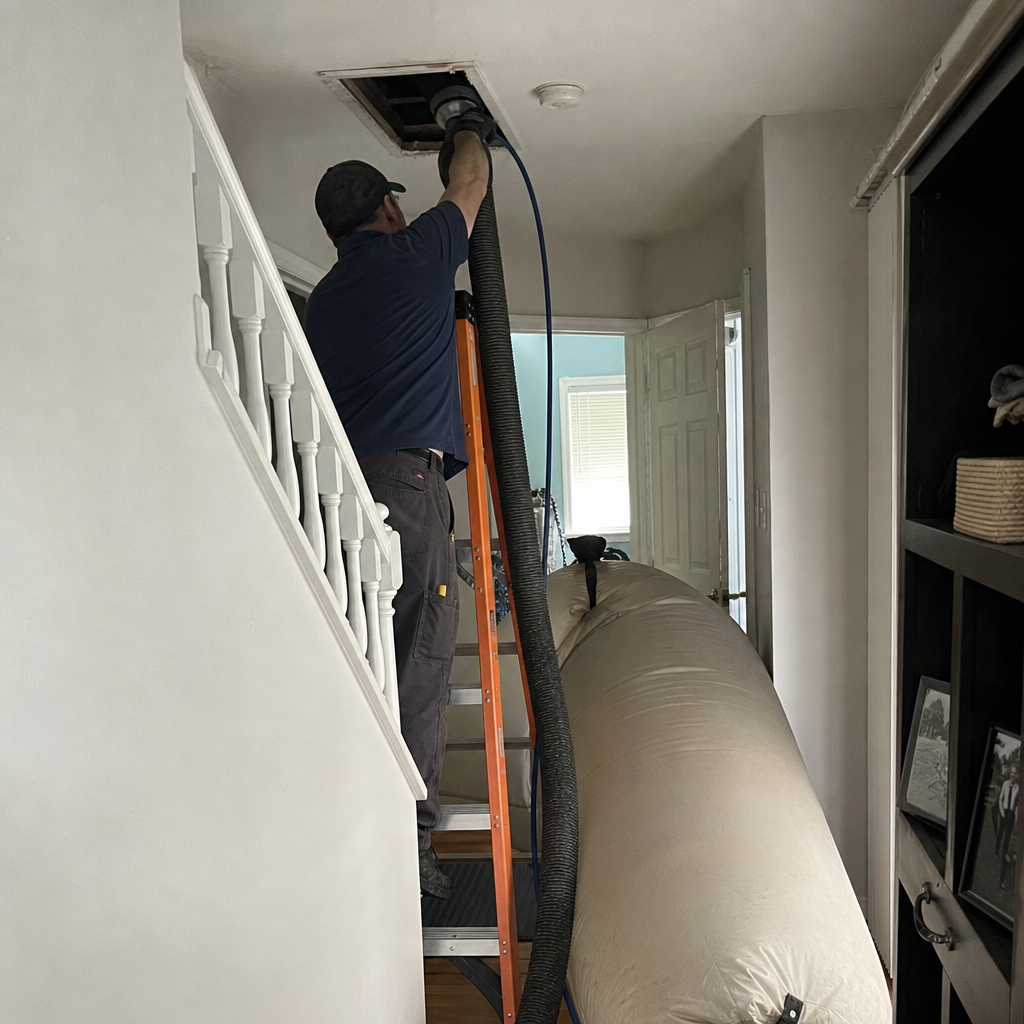
This is the model Thomas Hernandez built with Air Duct Cleaning in Dayton over two decades. Your owner is your technician. The person who answers your questions on the phone is the same person who inspects your system, operates the Rotobrush and Nikro equipment, and ensures the job meets the standard that bears their name. There’s no information loss between assessment and execution, no crew quality lottery, and no corporate abstraction layer when you need follow-up.
The practical differences for Dayton homeowners:
- Consistency: Every job reflects the same 20 years of hands-on experience, not the variable training of whoever was available that day.
- Problem-solving: When an unexpected issue arises — a collapsed flex duct in a Centerville crawl space, a seized access panel in a Dayton historic home — the owner has the authority and knowledge to adapt immediately, not escalate to a manager.
- Long-term accountability: An owner-operator’s reputation in a market like Dayton is personal and cumulative. Thomas Hernandez’s 113 verified reviews averaging 4.7 stars represent individual customer relationships, not aggregated crew performance.
- Equipment investment: Owner-operators who remain hands-on invest in professional-grade systems they personally operate. Our Rotobrush and Nikro equipment represents capital commitment to quality that dispatcher models rarely match.
This isn’t to suggest all multi-crew companies are inferior or all owner-operators are excellent. But the accountability structure is different, and for a service as technically specific as duct cleaning — where the difference between proper and improper technique is invisible to the homeowner until problems emerge — that structure matters profoundly.
How to Structure a Walkthrough That Tests Real Knowledge
The pre-job assessment is your best opportunity to evaluate competence before committing. A contractor who rushes this stage will rush the cleaning. Here’s how to conduct a walkthrough that reveals actual expertise versus scripted confidence.
Step 1: Start at the Air Handler
Ask the contractor to begin at your furnace or air handler, not at the vents. This is counterintuitive — most homeowners think of duct cleaning as “the vents” — but the air handler is the system’s heart. A knowledgeable technician will want to see:
- Filter type and condition (Are you using the restrictive 1-inch pleated filters that strain blowers?)
- Evaporator coil access and condition
- Blower assembly cleanliness
- Duct connection points and sealing quality
If the contractor suggests cleaning ducts without assessing the air handler, they’re treating symptoms without examining the source. In Dayton’s climate, where summer humidity loads coils heavily, this omission is particularly telling.
Step 2: Map the Duct System Together
Ask the contractor to trace the duct runs with you: main trunk locations, branch takeoffs, return pathways. In Dayton’s split-level and bi-level homes common in suburbs like Riverside and Huber Heights, return duct routing is often unconventional — through closets, soffits, or garage connections. A contractor who can’t follow your system’s logic can’t clean it thoroughly.
Specific questions to pose:
- “Where does this return duct connect to the main trunk?” — Tests spatial understanding of your specific system.
- “How will you access the trunk line given this finished basement ceiling?” — Tests problem-solving for your actual constraints.
- “What duct material is this section, and does that change your cleaning method?” — Tests material-specific knowledge. Flex duct, fiberglass duct board, and galvanized steel each require different approaches.
Step 3: Discuss Dayton-Specific Factors
Introduce a local variable and observe the response:
- “This house was built in 1965 — should I be concerned about asbestos in the duct insulation?”
- “We get a lot of agricultural dust from the fields west of town — does that affect filter selection?”
- “The humidity here in summer seems to make the upstairs muggy even with the AC running — could that be a duct issue?”
Generic responses (“We handle all types of homes” or “Humidity is always a concern”) indicate a contractor working from a national playbook. Specific references to Dayton’s climate patterns, agricultural surroundings, or housing stock demonstrate genuine local experience.
Step 4: Request a Written Scope Before Leaving
A competent contractor can summarize the work in writing immediately: vent counts, access points, equipment to be used, estimated duration, and total cost. Vagueness at this stage predicts vagueness in execution. If you’re told “I’ll email something later,” you’ve learned something about their operational discipline.
What Air Duct Cleaning Costs in Dayton — And Why It Varies
Understanding legitimate pricing helps you recognize both scams and quality work. In Dayton’s market, costs reflect system complexity, accessibility, and the thoroughness of the service — not just the number of vents.
| Service Level | Typical Dayton Range | What’s Included | Best For |
|---|---|---|---|
| Basic vent cleaning only | $250–$400 | Supply and return vent covers and immediate connections | Recent construction, minimal dust, maintenance cleaning |
| Standard full-system cleaning | $350–$650 | All vents, main trunk lines, air handler inspection, basic filter replacement | Most Dayton single-family homes, 3–5 years since last cleaning |
| Comprehensive with sanitizing | $500–$900 | Full system cleaning plus EPA-registered sanitizing, coil cleaning if accessible, dryer vent cleaning | Allergy sufferers, post-renovation, musty odor issues, pet households |
| Complex or accessibility-challenged | $700–$1,200+ | Custom access creation, collapsed duct repair, extensive contamination remediation | Historic homes, finished basements with sealed access, known rodent or mold issues |
Dayton-specific pricing factors:
- Home age and access: Pre-1970s homes in Dayton’s core neighborhoods often require access creation through plaster or finished surfaces, adding labor and repair costs.
- System type: Heat pumps with indoor coils require additional attention; homes with zoning systems have more complex duct networks.
- Contamination level: Dayton’s agricultural surroundings and pollen cycles mean rural and suburban systems often load faster than urban equivalents.
- Add-on services: Dryer Vent Cleaning in Dayton is frequently bundled with duct cleaning and should be priced separately for transparency. Similarly, HVAC Cleaning in Dayton that includes coil and blower service extends beyond basic duct scope.
Quotes below $200 for “whole house” cleaning in Dayton should trigger immediate skepticism. These operations typically spend 45 minutes on-site, use consumer-grade equipment, and leave significant debris. The true cost reveals itself in shortened HVAC lifespan, persistent air quality issues, or the need to hire a competent contractor to redo the work.
Common Mistakes to Avoid
- Booking based on coupon value alone. That $89 mailer in your Dayton mailbox covers a superficial vent wipe, not a system cleaning. The upsell begins on arrival, or the job simply fails to deliver measurable improvement.
- Assuming NADCA logo = guaranteed quality. Verify membership directly on nadca.com; don’t accept website badges at face value. Even verified membership doesn’t ensure competent execution.
- Neglecting to ask about the actual technician. In dispatched-crew models, you won’t know who’s entering your home until they arrive. For security and quality, confirm who performs the work before booking.
- Ignoring the air handler. Duct cleaning without inspecting and addressing the blower, coil, and filter is like washing your car’s exhaust pipe while the engine smokes. Insist on air handler assessment.
- Accepting verbal quotes. Dayton’s home service market includes operators who “forget” verbal promises or claim “I said starting at, not including.” Written scope protects both parties.
- Scheduling without seasonal awareness. Dayton’s peak seasons (spring allergy season, fall pre-heating) book solid. Rushing to “get it done before” creates pressure that benefits high-volume, low-quality operators.
- Failing to verify insurance independently. Ask for a certificate of insurance naming you as additional insured for the project date, or verify directly with the carrier. “Fully insured” is a phrase, not proof.
When to Call a Professional
Certain scenarios in Dayton homes demand immediate professional assessment rather than continued monitoring. Visible mold growth inside ductwork or on the air handler requires identification of the moisture source and proper remediation — not just cleaning. Persistent musty odors that intensify when the HVAC runs suggest microbial contamination that household solutions won’t address. If you’ve completed renovation work, particularly in older Dayton homes where disturbance of lead paint or asbestos is possible, professional cleaning with appropriate containment is essential before system restart.
Similarly, if your energy bills have risen without explanation or rooms show uneven heating and cooling, duct obstruction or leakage may be the cause — conditions that cleaning alone won’t resolve without additional sealing or repair. Rodent or insect infestation in ductwork requires both pest remediation and thorough system cleaning with sanitizing.
Titan Air Duct Cleaning Greater Dayton offers free estimates in Dayton — call (866) 834-6947. Thomas Hernandez personally assesses each system and provides written scope before any work begins, with no pressure to book immediately.
Frequently Asked Questions
Visible dust debris blowing from vents, persistent dust accumulation on surfaces shortly after cleaning, musty or stale odors when the HVAC operates, and worsening allergy symptoms among household members are the most reliable indicators. In Dayton, where seasonal pollen loads are significant, many homeowners schedule cleaning every 3–5 years as preventive maintenance. If your system has never been cleaned and your home is more than 10 years old, inspection is warranted regardless of visible symptoms.
No — Ohio has no licensing requirement specific to air duct cleaning, and NADCA membership or certification is entirely voluntary. NADCA membership indicates agreement with industry standards and maintenance of insurance, while ASCS or VMT certification indicates passing a written exam on those standards. Neither guarantees quality execution. Always verify claimed NADCA membership directly through nadca.com rather than accepting website logos.
A thorough cleaning of a typical Dayton single-family home with 10–15 vents requires 3–5 hours. Jobs completed in 60–90 minutes almost certainly involve only vent surface cleaning without trunk line attention. Complex systems, significant contamination, or additional services like coil cleaning extend this timeline. Be wary of contractors who schedule multiple jobs per day with insufficient time allocation — this predicts rushed work.
Improper technique can damage flex duct, dislodge connections, or compromise seals. Aggressive brush systems in brittle fiberglass duct board can create holes. In Dayton’s older homes with original galvanized steel, improper negative air pressure can stress aging seams. These risks are minimized by contractors who assess duct material before selecting equipment and method — another reason equipment specification matters in your vetting process.
Air duct cleaning addresses the distribution network: supply and return ducts, trunk lines, and vents. HVAC cleaning extends to the air handler components: evaporator coil, blower assembly, and often filter replacement. In Dayton’s climate, where summer humidity creates substantial coil loading, HVAC cleaning often delivers more noticeable performance improvement than duct cleaning alone. Titan Air Duct Cleaning Greater Dayton provides both services, with scope tailored to your system’s actual condition.
Expect $350–$650 for standard full-system cleaning of a typical single-family home, with smaller homes or basic services at the lower end and larger homes with sanitizing or accessibility challenges at the higher end. Quotes below $250 typically indicate limited scope or equipment shortcuts; quotes above $800 without clear justification for complexity warrant detailed explanation. Call (866) 834-6947 for an exact quote — estimates are free and include written scope.
Yes, if it’s been more than a year since your last dryer vent cleaning. Lint accumulation creates fire risk and reduces dryer efficiency — in Dayton’s older homes with longer vent runs through multiple stories, this risk is elevated. Bundling with duct cleaning reduces trip charges and ensures coordinated scheduling. Titan Air Duct Cleaning Greater Dayton includes dryer vent assessment with every duct cleaning estimate.
The Bottom Line
Hiring an air duct cleaning contractor in Dayton requires active vetting because Ohio’s regulatory vacuum places the burden entirely on you. The three questions about equipment, your specific concerns, and technician continuity will immediately sort specialists from pretenders. Verify NADCA claims independently. Demand written quotes with vent counts and equipment specifications. Use the walkthrough to test local knowledge and problem-solving ability. And recognize that owner-operated accountability — the model Thomas Hernandez has built over two decades — offers a structural quality advantage that franchise dispatching cannot replicate.
The cost of inadequate vetting isn’t just wasted money; it’s disturbed contamination without proper containment, damaged ductwork from wrong equipment, and missed conditions that degrade your HVAC system’s performance and lifespan. In Dayton’s varied housing stock and demanding climate, expertise isn’t a luxury — it’s the minimum requirement for a job worth paying for.
Written by Thomas Hernandez, Owner & Lead Technician at Titan Air Duct Cleaning Greater Dayton, serving Dayton since 2006.