
Duct Sealing Cost in Dayton, OH: What You’ll Actually Pay in 2024
Professional Affordable Duct Repair & Sealing in Dayton, OH typically runs $800–$2,400 for most residential systems, with smaller partial-seal jobs starting around $450 and full-system restorations on large mid-century homes reaching $3,200. Call (866) 834-6947 for a free in-home assessment — we inspect every joint before quoting. The final price depends on your home’s duct configuration, accessibility, and whether we’re sealing existing metalwork or replacing sections that have failed beyond repair.
Dayton’s housing stock tells the story. The 1940s–1960s ranch homes and split-levels that dominate Kettering, Huber Heights, and our inner-ring neighborhoods were built with sheet-metal ductwork joined by cloth duct tape and sheet-metal screws — materials that were never designed to last sixty-plus years. In the Miami Valley’s humidity-trapping river valley, that original tape dries, cracks, and fails faster than in drier climates. We’ve crawled through enough attics and crawlspaces to know: if your system has never been sealed with modern mastic compound or foil-backed tape, you’re likely losing 20–30% of your conditioned air into unconditioned spaces before it reaches a single room.
Why Your 1960s Kettering Split-Level Won’t Heat Evenly
If your mid-century Dayton home heats unevenly no matter what the HVAC tech does, the problem may not be the furnace — it may be that a third of your heated air is going into your crawlspace.
We’ve seen this exact scenario dozens of times. Homeowner calls an HVAC company for uneven temperatures. The technician checks the furnace, swaps the filter, maybe recommends a larger unit. But the real issue is air distribution: leaking supply ducts in an unconditioned crawlspace dump warm air into the dirt, while return leaks pull that same crawlspace air — dust, moisture, and all — back into the system. The furnace runs longer, rooms stay cold, and energy bills climb.
In Huber Heights, where Charles Huber built thousands of nearly identical all-brick ranches in the 1950s and 60s, the ductwork patterns are so consistent that once we’ve sealed one 1958 ranch, we essentially know the layout for the entire block. Undersized return chases, interior soffit runs prone to rodent intrusion, supply trunks with original cloth tape crumbling to the touch — these aren’t hypotheticals. They’re what we find on every third call.
The diagnostic sequence matters. Before we apply any sealant, we inspect and document every accessible joint using our Rotobrush inspection systems. Sealing over debris-packed joints locks the contamination in permanently — we’ve opened ducts where the previous “sealer” simply mastic’d over a decade of accumulated dust and microbial growth. That’s not sealing; it’s entombing a problem.
Two Sealing Methods: What Actually Works in Dayton’s Older Systems
Not all Best Duct Repair & Sealing in Dayton, OH is the same, and the method chosen should match the condition of your system — not what’s easiest to sell.
Mastic Compound: The Standard for Failing Metal Joints
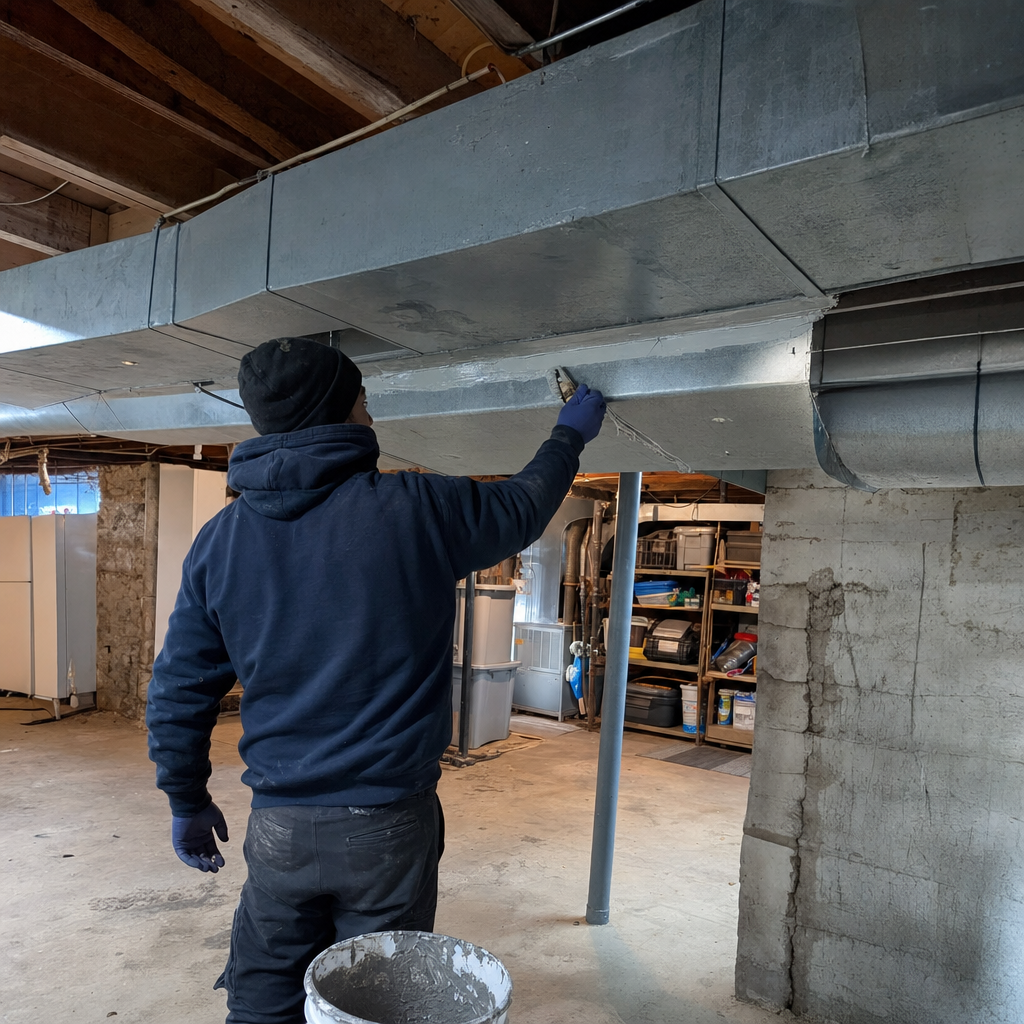
For Dayton’s original sheet-metal ductwork with separated or corroded joints, we use fiber-reinforced mastic compound — a thick, brush-applied sealant that remains flexible after curing and is rated for the temperature swings your ducts experience. Mastic fills gaps up to 1/4 inch, adheres to metal despite surface oxidation, and lasts 20+ years when properly applied.
This is hands-on work. Thomas Hernandez, our owner and lead technician, applies mastic personally on every sealing job — there’s no crew of trainees sent ahead of him. In a typical Huber Heights ranch, we’ll spend 4–6 hours in the crawlspace and attic, brushing mastic onto every longitudinal seam, transverse joint, and branch connection we can access. For homes with finished basements where ductwork is buried in soffits, we identify accessible entry points or recommend strategic drywall access — always with upfront discussion of the approach.
Foil-Backed Tape: For Intact Joints Needing Reinforcement
Where joints are still structurally sound but the original seal has failed, UL-181B-FX rated foil-backed tape provides a faster, less messy solution. Unlike the cloth duct tape found on most original Dayton installations — which was never HVAC-rated and fails within 5–10 years due to heat cycling — proper foil tape uses an acrylic adhesive that maintains bond at temperature extremes.
We use foil tape selectively: on newer metalwork, on repairs where mastic would be overkill, and as a reinforcement over mastic on high-vibration sections near the air handler. The key is matching material to condition, not defaulting to whatever’s in the truck.
Why We Don’t Recommend Aeroseal for Most Dayton Homes
Aeroseal — the pressurized sealant injection system heavily marketed to homeowners — has its place in new construction with accessible leaks throughout long duct runs. But for Dayton’s aging systems, it’s often oversold. Here’s why: Aeroseal seals from the inside, coating leak points with a thin polymer layer. It cannot address physically separated joints, corroded metal that needs replacement, or rodent-damaged sections. In a 1960s Kettering split-level with original cloth tape failures and screw-loosened seams, we’d be sealing over structural problems that need hands-on repair.
We’ve been called in after Aeroseal “sealed” systems that still leaked at major joints because the technology couldn’t reach the real failures. The homeowner paid $1,500–$2,500 for a partial solution, then paid again for proper mastic application. Our approach: diagnose first, match method to condition, quote honestly.
What Duct Sealing Costs in Dayton: Line-Item Breakdown
These ranges reflect How Much Does Duct Repair & Sealing Cost? (2026 Price Guide) — Dayton, OH for actual 2024 pricing for Dayton-area homes, based on linear footage of accessible ductwork, condition, and accessibility factors. Every quote follows an in-person inspection — we don’t price blind over the phone.
| Service Component | Price Range |
|---|---|
| Partial sealing (1–2 accessible zones, e.g., attic trunk only) | $450 – $750 |
| Standard full-system seal (ranch/split-level, accessible attic + crawlspace) | $800 – $1,400 |
| Complex full-system seal (finished basement access issues, multiple levels) | $1,400 – $2,400 |
| Seal + section replacement (corroded/damaged ductwork requiring new metal) | $1,800 – $3,200 |
| Return duct sealing/rebuild (oversized gravity-conversion trunks in older homes) | $900 – $1,800 |
| Dryer vent sealing/replacement (often bundled with duct sealing) | $150 – $350 |
Accessibility drives cost more than square footage. A Huber Heights ranch with an open crawlspace and attic hatch takes half the time of a Five Oaks Victorian where the original gravity-furnace trunk was converted to forced air and buried in a finished basement soffit. We price for the actual work, not a per-square-foot formula that penalizes or rewards you for home size alone.
Humidity complications also matter. Dayton’s Miami Valley location traps ground-level moisture that infiltrates older, uninsulated ductwork through condensation. When we find microbial growth inside ducts — common in systems that have leaked humid crawlspace air for years — we recommend pairing sealing with our Nikro-powered air quality sanitizing service. Sealing a contaminated system without cleaning it first traps that contamination permanently. We won’t do it.
What Drives Your Final Price: Four Factors We Assess
- Linear footage of compromised joints: More joints, more material, more labor. A simple ranch with a straight trunk and six branch takeoffs differs enormously from a sprawling split-level with ductwork zigzagging through multiple soffits.
- Accessibility: Open crawlspaces and unfinished basements allow direct access. Finished basements, buried ductwork, or tight attic clearances add time and sometimes require strategic access panel creation.
- Physical condition of existing metalwork: Separated joints need reassembly before sealing. Corroded sections need replacement. Rodent-damaged insulation needs removal. Each condition adds a repair layer before sealing begins.
- Pre-existing contamination: Heavy debris accumulation or microbial growth requires cleaning before sealing — logically, since sealing over contamination locks it in. We document this during inspection and price accordingly, never as a surprise add-on.
Our Duct Repair & Sealing service covers the full spectrum from minor joint reinforcement to complete system restoration. For homes where the original ductwork has simply reached end of life, we also fabricate and install replacement sections using proper sheet-metal techniques — not flex duct jammed into place, which we’ve seen too often from cut-rate operators.
The Miami Valley Humidity Factor: Why Sealing Matters More Here
Dayton’s river-valley geography isn’t just local color — it’s a functional factor in how your duct system performs. The Great Miami and Mad Rivers create a bowl effect that traps humidity at ground level more intensely than flatter surrounding terrain. During cooling season, unsealed return leaks in crawlspaces and basements pull that humid air directly into your duct stream.
The result: your air conditioner works harder to dehumidify air that shouldn’t be in the system, your indoor humidity stays elevated even when the thermostat reads 72°, and the moisture load encourages microbial growth inside ducts. We’ve measured return air at 65% relative humidity in July because the system was pulling from a damp crawlspace through a gap the size of a fist.
Proper sealing interrupts this cycle. By sealing returns as carefully as supplies, we prevent the infiltration of unconditioned, humid air. The system runs less, dehumidifies better, and the indoor environment stabilizes. In Dayton’s climate, return sealing is often more impactful than supply sealing — something less experienced technicians miss when they focus only on the ducts you can feel blowing air.
How Our Process Works: From Call to Sealed System
When you call (866) 834-6947, Thomas Hernandez handles the scheduling personally — no dispatch service, no call center. We’ll arrange a time that works, and he’ll arrive with our Rotobrush inspection equipment to assess your system firsthand.
The inspection takes 45–90 minutes depending on accessibility. We document every accessible joint with photo evidence, identify contamination levels, and flag any sections requiring replacement rather than sealing. You’ll receive a written quote with line-item breakdown before any work begins — no pressure, no same-day hard sell.
If you proceed, we schedule the sealing work, typically within 3–5 business days. Thomas performs the work himself, applying mastic or foil tape to every accessible joint, replacing damaged sections as quoted, and running a post-seal airflow verification to confirm improvement. For bundled cleaning+sealing jobs, we clean first, seal second — the only logical sequence, and one some competitors reverse to save a trip.
Our equipment matters. The Rotobrush and Nikro systems we deploy are the same brush-and-vacuum units used by commercial contractors — not consumer-grade gear dressed up for residential sales. When Thomas says he’ll apply mastic to every joint, he means every joint he can reach with a brush in hand, not a spray wand from ten feet away.
FAQs
Most homeowners pay between $800 and $2,400 for professional duct sealing in Dayton, with smaller partial jobs starting around $450 and complex restorations on large mid-century homes reaching $3,200. Call (866) 834-6947 for a free inspection and exact quote — estimates are always free, and we inspect every accessible joint before pricing.
Sealing is almost always cheaper than replacement for structurally sound metal ductwork — typically 40–60% less than full system replacement. However, if your ducts are corroded through, physically separated at multiple joints, or damaged by rodents, replacement sections become necessary. During our inspection, we’ll show you exactly which sections can be sealed and which need replacement, with line-item pricing for each so you can decide based on actual condition, not a blanket recommendation.
Yes — the Department of Energy estimates typical savings of 20–30% on heating and cooling costs for homes with significant duct leakage, and we’ve seen similar results in Dayton’s older housing stock. The savings are most dramatic in homes with ducts in unconditioned attics or crawlspaces, which describes most mid-century Dayton ranches and split-levels. Beyond energy, you’ll likely notice more even temperatures, less dust, and reduced humidity issues — benefits that show up before the utility bill does.
You need sealing if you can feel air leaking from joints, have rooms that never reach set temperature, see visibly disconnected or tape-failed joints, or have energy bills that seem high for your home size. You need cleaning if you see dust puffing from vents, smell musty or stale odors, or have allergy symptoms that worsen when the system runs. Many Dayton homes need both — we inspect first and recommend based on what we actually find, not a preset package. If I wouldn’t leave it in my own ducts, I’m not leaving it in yours.
Ready to Stop Losing Air — and Money — Into Your Crawlspace?
Call (866) 834-6947 today to schedule your free duct inspection with Thomas Hernandez, owner and lead technician. We’ll assess every accessible joint, show you exactly what’s failing and why, and quote honest pricing for sealing, repair, or replacement — no upsells, no surprises. Two decades of hands-on experience means we spot problems fast and fix them right the first time.
Written by Thomas Hernandez, Owner & Lead Technician at Titan Air Duct Cleaning Greater Dayton, serving Dayton, OH.