
Air Duct Sanitizing Service in Dayton, OH — What It Actually Does and When You Need It
Air duct sanitizing service in Dayton typically runs $250–$450 for a whole-home application when performed after proper mechanical cleaning, and it’s only warranted when your system shows active microbial growth or persistent musty odors that survive standard cleaning. At Titan Air Duct Cleaning Greater Dayton, our Air Quality & Sanitizing services apply EPA-registered sanitizers through our Rotobrush and Nikro equipment only after we’ve agitated and extracted the debris layer — never as a standalone spray that would simply coat the dirt underneath. If you’re noticing smells that return within days of a standard cleaning, or if you’ve got chronic allergy symptoms tied to your HVAC cycles, call us at (866) 834-6947 and Thomas Hernandez will inspect whether sanitizing makes sense for your specific duct system.
Why Sanitizing Into Dirty Ducts Fails Every Time
Spraying a sanitizing agent into dirty ducts is like applying antiseptic to a wound that hasn’t been cleaned — the debris underneath defeats the chemistry every time. We’ve seen this mistake repeatedly in Dayton homes, especially when homeowners hire carpet-cleaning franchises or handyman services that add “duct fogging” as an upsell without ever opening the ductwork.
Here’s what actually has to happen first:
- Mechanical agitation — We use Rotobrush contact cleaning or Nikro high-velocity vacuum systems to physically dislodge the biofilm, dust cake, and accumulated debris from duct walls.
- Negative-pressure extraction — A sealed vacuum collection captures the dislodged material so it doesn’t redistribute through your home.
- Visual verification — We camera-inspect the runs to confirm the surface is clean enough for sanitizer contact.
- Targeted application — Only then do we apply an EPA-registered product rated specifically for HVAC systems.
Without that sequence, you’re paying for chemistry that never reaches the surface it’s supposed to treat. The organic load acts as a shield — microbes underneath keep living, and the sanitizer bonds to dust instead of duct metal. In 20 years of doing this work, we’ve never seen a standalone fogging job deliver lasting results.
Dayton’s Humidity Problem — Why Miami Valley Ducts Grow What Columbus Ducts Don’t
Dayton sits in the Miami Valley, a river-valley bowl formed by the Great Miami and Mad Rivers that traps humidity more intensely than flatter surrounding terrain. This isn’t a poetic detail — it’s the reason we see far more microbial colonization in local ductwork than technicians encounter in Columbus or Cincinnati markets.
That ground-level moisture infiltrates older, uninsulated sheet-metal ductwork through condensation. In a typical Huber Heights ranch built in 1958, or a Kettering split-level from 1965, the original trunk lines run through unconditioned basements and crawl spaces where the metal surface temperature drops below the dew point for hundreds of hours each summer. Water beads on the interior. Dust that would stay dry elsewhere becomes a nutrient bed.
The result isn’t just “dusty ducts.” We’re talking about:
- Active mold growth on the interior surfaces of return plenums — the dark, damp, low-airflow zones where spores germinate
- Bacterial biofilms that produce the musty, wet-cardboard smell cycling through vents every time the blower kicks on
- Chronic recontamination after standard cleaning, because the moisture source was never addressed
This is why we don’t quote sanitizing over the phone. Thomas Hernandez inspects the duct system first — camera, moisture meter, and visual assessment — to determine whether we’re dealing with a contamination problem that warrants chemical treatment, or simply a dirty system that needs thorough mechanical cleaning and better sealing against humidity infiltration.
In neighborhoods like South Park and Five Oaks, where gravity furnaces were converted to forced air decades ago, the oversized trunk ducts and uninsulated returns create even more surface area for condensation. Those systems require significantly more time and equipment to clean properly, and sanitizing is only justified when inspection reveals active growth — not because the house is old, but because the inspection shows it.
What Separates Real Duct Sanitizers From Generic Fogger Products
Not every product labeled “sanitizer” belongs in your HVAC system. We work with Abatement Technologies and Guardsman — both manufacturers whose EPA-registered formulations are specifically rated for application in ductwork, with verified kill claims against the mold and bacterial species common in residential HVAC environments.
Here’s the distinction that matters:
| Product Type | EPA Registration | HVAC-Specific Label | Typical Cost Range in Dayton |
|---|---|---|---|
| Professional duct sanitizer (Abatement Technologies, Guardsman) | Yes — specific kill claims for HVAC contaminants | Yes — rated for use in ventilation systems | $250–$450 whole-home application |
| Generic “fogging” or deodorizing agent | Often registered as general disinfectant only | No — not labeled for forced-air application | $99–$199 (typically upsold without cleaning) |
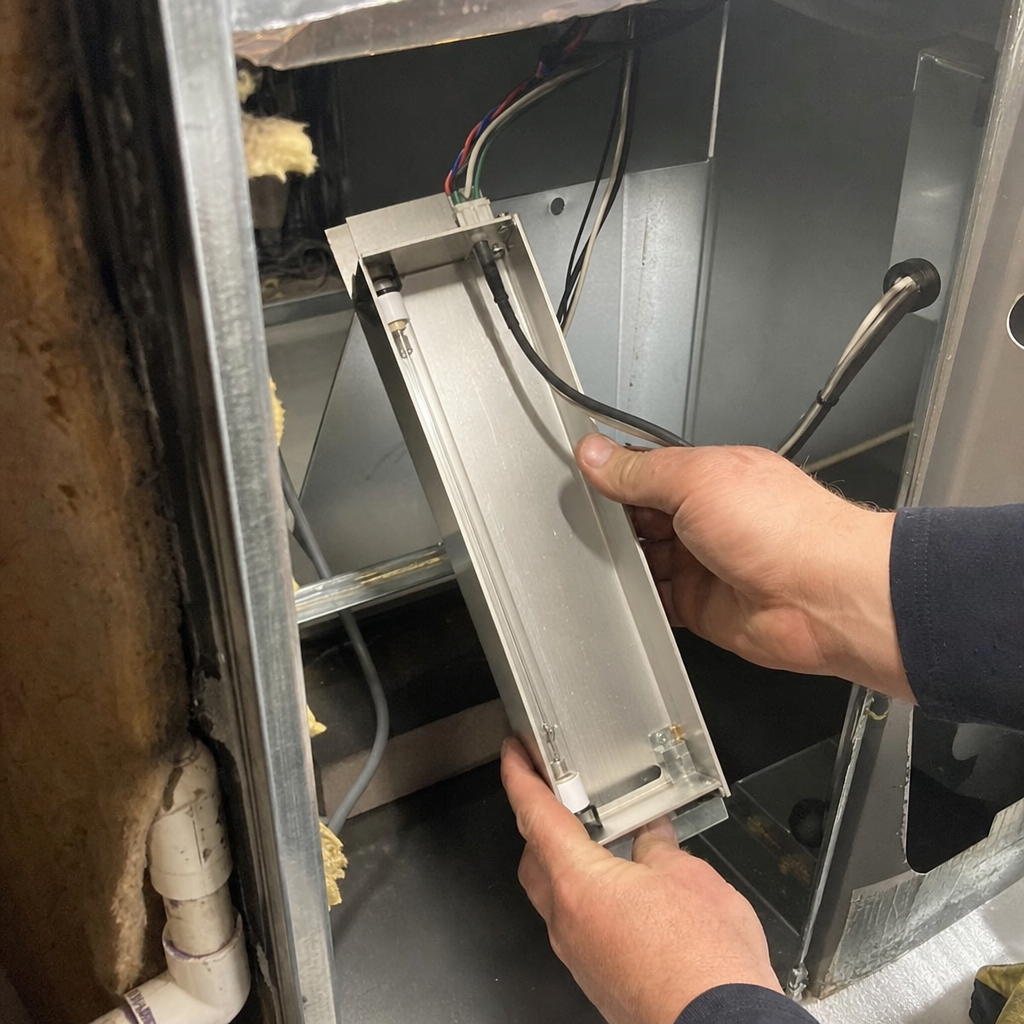
| Consumer-grade UV or ozone generator | Varies; ozone devices have EPA restrictions | Rarely | $150–$400 (equipment only, no application labor) |
The cheap fogging jobs you see advertised? Those products might be fine for bathroom tile. They’re not formulated to adhere to metal duct surfaces at HVAC airflow velocities, and they don’t have the surfactant chemistry to penetrate biofilm layers. Worse, some competitors use scented masking agents that temporarily cover odors while the underlying problem keeps growing.
If I wouldn’t leave it in my own ducts, I’m not leaving it in yours. That’s why we specify the product by manufacturer and registration status, and why we explain exactly what we’re applying before we apply it.
When Sanitizing Helps — And When It Doesn’t
We turn down sanitizing work when inspection shows it’s not warranted. This page exists partly to tell you that, because the companies that sell it to everyone erode trust in the service itself.
Sanitizing is justified when we find:
- Visible mold growth inside duct runs, confirmed by camera inspection
- Persistent musty or sour odors that return after mechanical cleaning alone
- Documented water intrusion history (basement flooding, roof leaks, condensate drain failures) with associated microbial contamination
- Occupants with documented mold sensitivity or immunocompromise where reducing viable spore load provides measurable benefit
Sanitizing is NOT justified when:
- The system is simply dusty — mechanical cleaning removes the allergen load without chemicals
- The moisture source is still active (leaking duct joint, unsealed return pulling crawlspace air) — we’ll seal and repair first, then reassess
- The homeowner expects permanent prevention — no sanitizer prevents regrowth if humidity and nutrients remain available
This honesty costs us some jobs. It earns us the 113 verified reviews averaging 4.7 stars — customers who were told what they actually needed, not what would inflate the invoice, making us a trusted choice for Best Air Quality & Sanitizing in Dayton, OH.
Common Local Scenarios We See in Dayton Homes
Every market has its patterns. After two decades working in the Miami Valley, these are the situations where sanitizing comes up most often — and what we actually do about them.
The Huber Heights Ranch With the 1958 Duct Layout
Nearly every home on a given Huber Heights street was built the same year by the same developer with the same ductwork configuration. A technician who learns the quirks of one 1958 Huber ranch — undersized return chases, interior soffit runs prone to rodent intrusion — essentially knows the layout for the entire block. We’ve cleaned and sanitized dozens of these systems where squirrels or mice accessed the soffit returns, leaving behind contamination that standard vacuuming won’t fully address. The sanitizing application follows sealing of the entry points; otherwise, we’re treating symptoms.
The Kettering Split-Level With the Never-Serviced Furnace
Mid-century split-levels in Kettering often have the original furnace and ductwork, now 60-plus years old, with zero documented cleaning history. The blower compartment and evaporator coil (if central AC was added later) become the primary contamination zones. We clean the full air pathway first — coils, blower, plenum, trunk lines, branches — then assess whether the accumulated biofilm warrants sanitizer application. Usually it does, because decades of condensation cycling have created layers that mechanical agitation alone won’t fully neutralize.
The South Park Conversion With the Oversized Trunk
Pre-WWII homes in South Park and Five Oaks had gravity (octopus) furnaces converted to forced air, leaving behind oversized, uninsulated trunk ducts that accumulate far more debris than modern systems. The volume of material is one problem; the surface area for condensation is another. These systems require significantly more time and equipment to clean, and the inspection often reveals active growth in the low points where condensate pools. Sanitizing is part of a complete protocol that includes sealing and sometimes structural repair — we don’t apply chemicals and walk away.
The Allergy Season That Never Ends
Dayton’s pollen counts are brutal, but some homeowners notice symptoms persist even when outdoor counts drop. If the HVAC system is cycling microbial contaminants from damp ductwork, the “allergy season” becomes year-round. We verify this with inspection, not assumption — camera evidence of growth, moisture readings, and correlation with symptom patterns. When sanitizing is warranted, we coordinate it with filter upgrades (often to Honeywell or Aprilaire media filters) and humidity control recommendations to reduce recurrence.
What the Process Looks Like From Your End
When you call (866) 834-6947, Thomas Hernandez answers — not a dispatcher, not a call center. He’s the person who arrives at your door, runs the inspection, and does the work.
Here’s how a typical sanitizing job unfolds:
- Phone consultation — We discuss your symptoms (odors, allergies, visible mold, water history) and schedule an inspection. No charge for the assessment.
- On-site inspection — Camera inspection of accessible duct runs, moisture readings, visual assessment of the blower compartment and coil. We show you what we find.
- Honest recommendation — If sanitizing is warranted, we quote it with the cleaning protocol it requires. If it’s not, we tell you that too, and quote only what you need.
- Mechanical cleaning — Full agitation and extraction with Rotobrush or Nikro equipment, depending on duct configuration and contamination type.
- Post-cleaning verification — Camera re-inspection to confirm surfaces are clean enough for sanitizer contact.
- Sanitizer application — EPA-registered product (Abatement Technologies or Guardsman) applied as a fine mist at specified coverage rates, with dwell time per manufacturer protocol.
- System restart and final check — We verify airflow balance, check for any residual odor, and confirm proper operation before we leave.
Most whole-home sanitizing jobs, when bundled with the required mechanical cleaning, are completed in a single day. The sanitizer itself requires a brief dwell period with the system off, typically 2–4 hours, before normal HVAC operation resumes.
Key Takeaways
- Sanitizing only works after thorough mechanical cleaning — sequence matters, and standalone fogging wastes your money
- Dayton’s Miami Valley humidity creates condensation conditions in older ductwork that accelerate microbial growth — this is a genuine local factor, not marketing fluff
- EPA-registered products rated for HVAC systems (Abatement Technologies, Guardsman) differ fundamentally from generic foggers
- Not every system needs sanitizing — we inspect first and recommend honestly
- Your owner is your technician: Thomas Hernandez handles every inspection and job personally
FAQs
How Much Does Air Quality & Sanitizing Cost? (2026 Price Guide) — Dayton, OH: whole-home air duct sanitizing service typically runs $250–$450 when performed after proper mechanical cleaning, with the total job (cleaning plus sanitizing) generally falling in the $400–$800 range depending on system size and accessibility. We don’t quote sanitizing alone because it would be ineffective — the required cleaning protocol is built into every sanitizing estimate. Call (866) 834-6947 for a free, on-site assessment and exact quote.
No — sanitizing reduces viable microbial load but does not permanently prevent regrowth if the underlying moisture source remains unaddressed. In Dayton’s humidity-trapping Miami Valley geography, persistent condensation in uninsulated ductwork will eventually support new growth unless we also seal leaks, improve insulation, or correct drainage issues. We identify and quote these structural fixes when inspection reveals they’re needed, rather than selling a chemical solution to a moisture problem.
We recommend occupants leave during application and the 2–4 hour dwell period that follows, as even EPA-registered products require ventilation before re-entry. The products we use — Abatement Technologies and Guardsman formulations — are rated for HVAC application at specified concentrations, but we err on the side of caution with exposure timing. We’ll coordinate the schedule to minimize disruption, and we never rush the dwell period to fit our calendar.
You likely need sanitizing if inspection reveals visible mold growth, persistent musty odors that survive standard cleaning, or documented water intrusion with associated contamination. If your ducts are simply dusty or have normal accumulation from Dayton’s pollen seasons, mechanical cleaning alone removes the allergen load without chemicals — but when growth is present, you’ll want to find Air Quality & Sanitizing Near Me in Dayton, OH that inspects first. Thomas Hernandez determines this through camera inspection and moisture assessment during your free estimate — we don’t sell sanitizing to systems that don’t warrant it. Call (866) 834-6947 to schedule.
Ready to Find Out What Your Ducts Actually Need?
We’ll give you a straight answer — and a clean system — without the upsell pressure you’ve probably experienced elsewhere. Call (866) 834-6947 today for a free inspection and estimate. Thomas Hernandez will handle your job personally, from the first phone call to the final system check.
Written by Thomas Hernandez, Owner & Lead Technician at Titan Air Duct Cleaning Greater Dayton, serving Dayton, OH.