
Last updated July 10, 2026
Air Duct Cleaning Permits, Codes & Inspections in OH: What You Need to Know
Here’s something most Dayton homeowners don’t realize until it’s too late: the brush-and-vacuum cleaning you schedule every few years likely needs zero paperwork, but the duct repair your “cleaner” casually mentioned mid-job? That might require a permit your contractor never pulled. In our two decades working inside homes across the Dayton metro — from the historic districts of Oregon to the newer builds in Centerville — we’ve seen too many homeowners discover unpermitted duct modifications during a pre-sale inspection, when the fix becomes expensive and time-sensitive. This guide explains exactly where Ohio draws the line between routine maintenance and regulated work, why Dayton’s local jurisdictions matter more than state defaults suggest, and how to protect yourself from liability that outlasts any cleaning appointment.
Quick Answer
Standard residential air duct cleaning in Ohio does not require a permit. However, duct repair, sealing that alters airflow capacity, modification of existing ductwork, or any work involving mechanical components falls under the Ohio Mechanical Code and typically requires permitting through your local building department. In Dayton, this means navigating different requirements between the City of Dayton and Montgomery County jurisdictions.
Table of Contents
- When Air Duct Cleaning Needs No Permit
- When Duct Repair Triggers Ohio Mechanical Code
- Dayton vs. Montgomery County: Jurisdiction Differences
- Mold Remediation: A Separate Regulatory Framework
- Unpermitted Work and Homeowner Liability
- What Documentation Your Contractor Should Provide
- Common Mistakes to Avoid
- When to Call a Professional
- Frequently Asked Questions
When Air Duct Cleaning Needs No Permit
The good news first: the service most Dayton homeowners actually need — thorough air duct cleaning — lives in a regulatory gray zone that favors simplicity. Under Ohio’s current building code framework, cleaning existing ductwork without altering its structure, capacity, or mechanical connections is classified as maintenance, not construction. No permit, no inspection, no delay.
What qualifies as permit-free cleaning? In our experience with thousands of Dayton-area jobs, this includes:
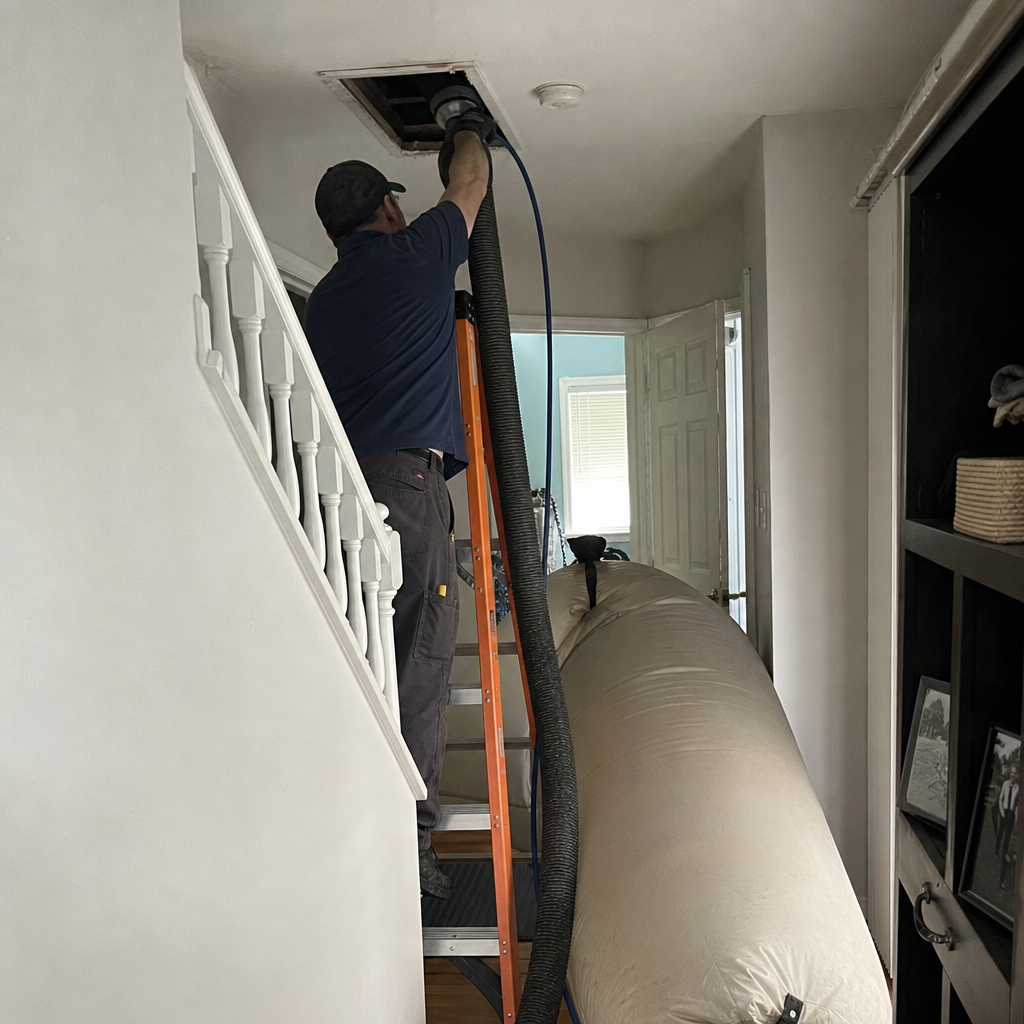
- Mechanical brush-and-vacuum cleaning of interior duct surfaces using systems like our Rotobrush and Nikro equipment
- Contact vacuuming of registers, grilles, and accessible trunk lines
- Compressed air washing of supply and return branches
- Application of EPA-registered sanitizers following cleaning, provided no structural modification occurs
The Ohio Mechanical Code (OMC), which adopts the International Mechanical Code with state amendments, regulates the installation, alteration, and repair of mechanical systems. Cleaning — defined as the removal of accumulated particulate matter without changing system design — isn’t listed among regulated activities. This distinction matters because it allows homeowners to maintain indoor air quality without bureaucratic overhead.
However, we’ve encountered situations in Dayton’s older housing stock — particularly in neighborhoods like Grafton Hill or the Wright-Dunbar area — where “cleaning” reveals deterioration that tempts contractors into informal repairs. A disconnected flex duct behind a register. A rusted collar. A compromised seal. The moment a technician reaches for tape, mastic, or replacement materials without discussing permits, you’re crossing into regulated territory without documentation.
Our approach at Titan Air Duct Cleaning Greater Dayton home is straightforward: we clean with professional-grade equipment, document what we find with photo evidence, and flag any repair needs for a separate, properly permitted scope of work. Your owner is your technician — Thomas Hernandez handles every job personally — so there’s no game of telephone where critical compliance details get lost between sales and execution.
When Duct Repair Triggers Ohio Mechanical Code
The threshold for permitting isn’t always obvious, and that’s where homeowners get caught. The Ohio Mechanical Code Section 106.1 requires permits for “the installation, alteration, repair, replacement, or relocation of any mechanical system.” The critical word is “alteration” — and its interpretation varies by jurisdiction and inspector.
Here’s how we break it down for Dayton homeowners based on two decades of field experience:
- Permit typically required: Ductwork replacement exceeding 10 linear feet; modification of trunk line diameter or material; relocation of supply or return registers; installation of new duct runs to previously unserved spaces; repair involving structural supports or fire-rated assemblies
- Permit sometimes required (jurisdiction-dependent): Extensive sealing of disconnected ducts; replacement of damaged flex duct sections; repair of HVAC connections affecting airflow balance
- Permit generally not required: Register replacement of same size; minor sealing of accessible joints with mastic; filter upgrades; cleaning and sanitizing
The OMC’s reference to “repair” creates ambiguity that benefits neither homeowners nor legitimate contractors. In practice, many residential duct repairs in Dayton occur without permits because the scope seems minor and enforcement is complaint-driven. But “seems minor” and “is legally compliant” are different standards — and the gap becomes visible during real estate transactions, insurance claims, or post-disaster inspections.
We’ve seen this specifically in Dayton’s 1970s-era subdivisions like Kettering and Beavercreek, where original fiberglass ductboard is failing simultaneously across neighborhoods. Homeowners who’ve had “cleaning” companies patch deteriorating sections without permits discover during pre-sale inspections that the work lacks documentation. The buyer’s inspector flags it. The deal stalls. The homeowner pays twice — once for the original work, again for permitted remediation.
Two decades of hands-on experience has taught us that transparency about permitting protects everyone. When we identify repair needs during a Air Duct Cleaning in Dayton service, we explain the regulatory boundary, provide written documentation of our cleaning scope, and recommend licensed HVAC contractors for permitted repair work when needed.
Dayton vs. Montgomery County: Jurisdiction Differences
Ohio delegates mechanical code enforcement to local jurisdictions, and Dayton’s fragmented municipal landscape creates real variation in how ductwork is regulated. Understanding which jurisdiction governs your property — and how that jurisdiction interprets the OMC — matters more than most contractors acknowledge.
City of Dayton: The city’s Building Regulation Division enforces the OMC within municipal boundaries. For residential mechanical work, the city generally requires permits for ductwork modification, new installation, or replacement exceeding repair thresholds. The City of Dayton’s interpretation tends toward stricter documentation for work in multi-family structures and historic districts, where fire separation and preservation requirements add layers. Permit turnaround typically runs 3-5 business days for residential mechanical, with inspection required before closure.
Montgomery County (unincorporated areas): The Montgomery County Building Regulation Division serves properties outside municipal boundaries. Their residential mechanical permit process follows OMC defaults more closely, with somewhat broader discretion for repair work. However, county inspectors we’ve encountered over twenty years in the trade consistently flag ductwork that affects combustion appliance venting — a critical consideration for Dayton homes with gas furnaces in basement mechanical rooms.
Surrounding municipalities: Kettering, Centerville, Beavercreek, Oakwood, and other Dayton suburbs operate independent building departments with their own permit fee schedules and inspector interpretations. Oakwood, for instance, maintains particularly detailed requirements for work in its designated historic areas. Huber Heights and Riverside have streamlined online permitting that can actually expedite compliant repair work compared to walk-in processes.
The practical implication: a duct repair that passes without comment in unincorporated Montgomery County might require documentation in the City of Dayton, and the contractor’s familiarity with your specific jurisdiction matters. We’ve built relationships with inspectors across these departments over two decades, not to shortcut code — but to ensure our recommendations align with actual local practice.
Climate factors specific to Dayton also influence code application. Our humid continental climate, with summer highs regularly exceeding 85°F and winter lows below 20°F, places significant thermal load on ductwork. Condensation issues in unconditioned attic spaces — common in Dayton’s 1950s-1980s housing stock — can accelerate deterioration that triggers repair-permit thresholds faster than in milder climates. When we document moisture damage during cleaning, we’re flagging not just an air quality issue but a potential code compliance timeline.
Mold Remediation: A Separate Regulatory Framework
Here’s where many duct cleaning companies — and homeowners — stumble into regulatory territory they don’t recognize. Cleaning dust and debris from ducts is unregulated maintenance. Addressing visible mold growth inside ductwork triggers an entirely separate compliance framework that most “air duct cleaning” operations aren’t equipped to handle legally.
Ohio does not maintain a standalone mold remediation licensing statute comparable to states like New York or Texas. However, the Ohio Department of Health and Ohio EPA govern mold-related activities through multiple intersecting regulations:
- Ohio Revised Code 3718 governs indoor air quality in schools and public buildings, with mold assessment and remediation protocols that inform residential best practices
- Ohio EPA asbestos regulations apply when mold remediation disturbs suspect building materials in pre-1980 structures — common in Dayton’s historic neighborhoods
- OSHA worker protection standards require specific containment, PPE, and disposal protocols for mold remediation in occupied structures
- Professional standards from organizations like ACGIH and AIHA establish assessment and clearance criteria that insurance companies and courts reference
The critical distinction: a company advertising “mold removal” or “mold treatment” in ducts without following remediation protocols — proper containment, negative air pressure, HEPA filtration, post-remediation verification — is operating outside recognized professional standards even if no specific Ohio license is violated.
In Dayton’s river-adjacent neighborhoods like Riverdale and Carillon, we’ve encountered chronic moisture issues that produce recurrent mold in ductwork. The Ohio River valley’s humidity patterns, combined with older foundation drainage, create conditions where surface cleaning alone guarantees recurrence. Our approach: we clean with professional-grade Rotobrush and Nikro systems, document any suspected mold with photography, and refer to certified mold remediation specialists when growth exceeds maintenance-cleaning scope. We don’t blur the line between cleaning and remediation because the liability transfer to homeowners is too significant.
Products matter here too. We use Guardsman and Abatement Technologies sanitizers registered for HVAC application — not consumer-grade treatments that leave residues or fail to achieve required contact times. This specificity matters for documentation if health concerns or insurance questions arise later.
Unpermitted Work and Homeowner Liability
The hidden cost of unpermitted ductwork isn’t the work itself — it’s the downstream consequences that activate when documentation matters most. We’ve consulted with Dayton homeowners who discovered this painfully, and the pattern is consistent enough to warrant explicit warning.
Insurance claims: When HVAC-related fire, water, or structural damage triggers a homeowner’s claim, insurers routinely investigate whether modifications to the system were permitted. Unpermitted ductwork alterations — even repairs performed years earlier — can support denial or reduced coverage arguments. We’ve seen this in Dayton’s older housing stock where knob-and-tube electrical remnants, combined with unpermitted HVAC modifications, created compound liability scenarios.
Real estate transactions: Montgomery County’s residential disclosure form requires sellers to identify “any structural modification or system alteration not performed with required permits.” Unpermitted duct repairs discovered during buyer inspection become negotiation leverage — or deal-killers. In Dayton’s competitive market, a $300 permit omission can cost thousands in price reductions or repair credits.
Warranty and product claims: HVAC equipment manufacturers increasingly deny warranty claims where installation or connected ductwork violates code. A furnace failure traced to airflow restriction from unpermitted duct modification becomes a homeowner expense, not a covered repair.
Health and habitability disputes: Rental properties in Dayton’s university-adjacent neighborhoods — particularly around University of Dayton and Sinclair Community College — face heightened scrutiny. Unpermitted ductwork affecting ventilation rates can support tenant habitability claims, especially where mold or carbon monoxide concerns arise.
The documentation gap is usually discovered too late for simple correction. Permits can’t be retroactively obtained for completed work in most Ohio jurisdictions — the inspection sequence is integral to permit validity. This means unpermitted repairs must often be removed and redone under new permits, at full replacement cost.
Our two decades in Dayton homes has made us conservative about this boundary. When HVAC Cleaning in Dayton reveals conditions requiring repair, we document, recommend, and connect — we don’t improvise solutions that transfer liability to homeowners.
What Documentation Your Contractor Should Provide
Regardless of permit status, legitimate contractors produce documentation that protects both parties. The absence of this paperwork is itself a signal — and not a favorable one. Here’s what we provide on every Titan Air Duct Cleaning Greater Dayton job, and what you should demand from any contractor:
- Written scope of work distinguishing cleaning from any repair or modification, with explicit statements about permit requirements for recommended additional work
- Pre-service and post-service photographic documentation of accessible ductwork conditions, dated and referenced to specific registers or duct sections
- Equipment and product specifications — for our work, this means Rotobrush or Nikro system identification, and EPA registration numbers for any applied sanitizers from our Guardsman or Abatement Technologies product lines
- Completion certificate with service date, technician identification, and warranty terms for workmanship
- Insurance and bonding verification — we carry general liability and workers compensation; while we don’t publish specific policy numbers, we provide certificates of insurance upon request
For permitted work performed by licensed HVAC contractors, documentation expands to include permit application copies, inspection sign-offs, and as-built drawings where modifications occurred. We maintain relationships with Dayton-area HVAC contractors who share our documentation standards, ensuring continuity when cleaning transitions to repair.
The “your owner is your technician” model matters here. Thomas Hernandez personally generates and reviews every documentation package — there’s no administrative layer where details get diluted or lost. When we’ve serviced the same Dayton home multiple times over fifteen years, our records provide continuity that franchise operations with high technician turnover simply cannot match.
Common Mistakes to Avoid
- Hiring based on lowest price without verifying permit awareness. Cut-rate operators in Dayton often treat all ductwork as maintenance, avoiding permit costs and inspections that would reveal their inadequate scope. The savings evaporate when unpermitted work requires remediation.
- Assuming “cleaning” covers repair. We’ve recovered disconnected ducts and sealed compromised joints that previous “cleaners” simply worked around. Ask explicitly: does your scope include repair, and if so, under what permit authority?
- Ignoring jurisdiction boundaries. A contractor familiar with Montgomery County defaults may misapply City of Dayton requirements, or vice versa. Verify your contractor understands your specific jurisdiction.
- Accepting verbal assurances about mold. In Dayton’s humid climate, duct mold is common enough to attract unqualified treatments. Demand EPA registration numbers for any applied product, and written scope distinguishing cleaning from remediation.
- Failing to retain documentation. Service records, photos, and certificates belong with your permanent home files — not in an email you’ll delete. These documents transfer with property ownership and protect resale value.
- Permitting insurance gaps. Verify that your contractor’s coverage specifically includes the work performed. Some general liability policies exclude mold remediation or mechanical modification — critical gaps if something goes wrong.
When to Call a Professional
Certain scenarios demand immediate professional assessment beyond routine maintenance scheduling. Call for evaluation if you’re experiencing persistent musty odors from registers, visible mold growth on duct surfaces, sudden airflow reduction following any contractor work, or if you’re preparing to sell and lack documentation for prior ductwork modifications. Dayton’s climate extremes — summer humidity that peaks above 70% and winter temperature swings that stress thermal envelopes — accelerate conditions that start minor and become major.
Titan Air Duct Cleaning Greater Dayton offers free estimates in Dayton — call (866) 834-6947. Thomas Hernandez personally evaluates every project, with two decades of hands-on experience determining whether your situation requires straightforward cleaning or documented coordination with permitted repair specialists. Our complete air pathway approach means we assess ducts, equipment, and ventilation as an integrated system, not isolated components.
Frequently Asked Questions
No. Routine air duct cleaning — mechanical brushing, vacuuming, and sanitizing of existing ductwork without structural modification — is classified as maintenance under the Ohio Mechanical Code and does not require permitting. If a contractor claims otherwise for basic cleaning, request the specific code section they’re citing. For cleaning scope clarification in your specific Dayton home, call (866) 834-6947 — estimates are free.
Within Dayton city limits, permits are generally required for ductwork replacement exceeding 10 linear feet, modification of trunk line sizing or material, relocation of supply/return registers, and any new duct installation. Montgomery County’s unincorporated areas follow similar thresholds with somewhat broader inspector discretion for repair work. The specific jurisdiction governing your property — city versus county — determines filing location and fee schedule. We’ve navigated both systems for two decades and can direct you appropriately.
Direct fines for residential mechanical work are uncommon in Ohio’s complaint-driven enforcement system, but the consequential penalties — insurance denial, sale complications, warranty voidance — often exceed any municipal fine. Dayton’s building departments prioritize compliance over punishment when issues are disclosed proactively, but discovered concealment triggers stricter response. The 113 customers who’ve verified our work at 4.7 stars didn’t choose us for permit avoidance — they chose documentation and transparency.
Request the permit application number and verify directly with the issuing building department — City of Dayton Building Regulation or Montgomery County Building Regulation for most area properties. Legitimate contractors provide this without hesitation; reluctance is a significant red flag. For work we coordinate with licensed HVAC partners, we facilitate this verification as part of our documentation package.
Ohio does not issue specific mold remediation licenses, but proper mold remediation in ducts requires containment protocols, negative air pressure, HEPA filtration, and post-remediation verification that exceed standard cleaning scope. Companies advertising “mold removal” without these capabilities operate outside recognized professional standards. We clean and document suspected mold, then refer to qualified remediation specialists when growth exceeds maintenance parameters — protecting your health and your liability exposure.
Disclose proactively on Ohio’s residential property disclosure form, then obtain evaluation from a licensed HVAC contractor to determine whether the work meets code despite lacking permits. Some Dayton-area jurisdictions allow “legalization” inspections for work that would pass current standards, though this is inspector-dependent and not guaranteed. Early assessment — ideally before listing — preserves negotiation position. We’ve assisted numerous Dayton sellers with documentation reviews and remediation referrals to smooth transaction timelines.
The Bottom Line
Ohio’s regulatory framework for air duct work is straightforward at the edges and murky in the middle — which serves no one well. Cleaning needs no permit. Repair often does. The gap between them is where homeowners absorb risk they rarely recognize until activated by insurance claims, health concerns, or real estate transactions. In Dayton’s specific jurisdiction landscape, local knowledge separates contractors who protect you from those who expose you. Documentation, transparency about boundaries, and willingness to refer rather than improvise are the markers of legitimate operation. Two decades of hands-on experience has taught us that the short-term convenience of permit avoidance always costs more than the upfront compliance investment.
Written by Thomas Hernandez, Owner & Lead Technician at Titan Air Duct Cleaning Greater Dayton, serving Dayton since 2006.