
Last updated July 10, 2026
The Complete Guide to Air Duct Cleaning in Dayton
Here’s something most Dayton homeowners don’t realize: the average residential duct cleaning takes two to three hours for a reason. We’ve been called to homes in Oakwood and Kettering where a previous “technician” spent 22 minutes from van arrival to departure—and left the system virtually untouched. In a market flooded with $99 coupon specials, the gap between a legitimate cleaning and a theatrical performance has never been wider. This guide walks you through exactly what professional air duct cleaning involves, why Dayton’s housing stock demands specific expertise, and how to read a quote like someone who’s spent two decades inside local ductwork.
Quick Answer
Professional air duct cleaning in Dayton typically costs $400–$900 for a standard single-family home and takes 2–4 hours using truck-mounted or commercial portable negative air systems. A legitimate service cleans supply ducts, return ducts, and the air handler unit; inspects with before-and-after cameras; and documents debris removal rather than simply running a brush through visible register openings.
Table of Contents
- What Legitimate Air Duct Cleaning Actually Involves
- Why Equipment Makes the Difference: Truck-Mounted vs. Portable Systems
- Dayton’s Older Housing Stock: What Pre-1980 Ductwork Hides
- What Before-and-After Camera Inspections Should Reveal
- Supply Ducts, Return Ducts, and the Air Handler: The Complete Pathway
- How to Read a Quote: What’s Included vs. What’s Upsold
- Common Mistakes to Avoid
- When to Call a Professional
- Frequently Asked Questions
- The Bottom Line
What Legitimate Air Duct Cleaning Actually Involves
A proper air duct cleaning isn’t a surface wipe-around. It’s a systematic extraction of accumulated debris from the entire forced-air pathway—every surface that conditioned air touches before reaching your rooms. After two decades in Dayton homes, we’ve developed a process that addresses what actually builds up here: fine limestone dust from our region’s aggregate-rich soil, seasonal pollen loads that peak in late May and early September, and the accumulated skin cells, pet dander, and cooking particulates that settle in ductwork over years of occupancy.
The process breaks down into distinct phases:
- System assessment and access creation. We inspect your HVAC configuration, identify all supply and return registers, and determine whether duct access panels need to be cut (and later sealed) or if existing openings suffice. In Dayton’s ranch-style homes common in Belmont and Patterson Park, this often means accessing crawl space or basement trunk lines.
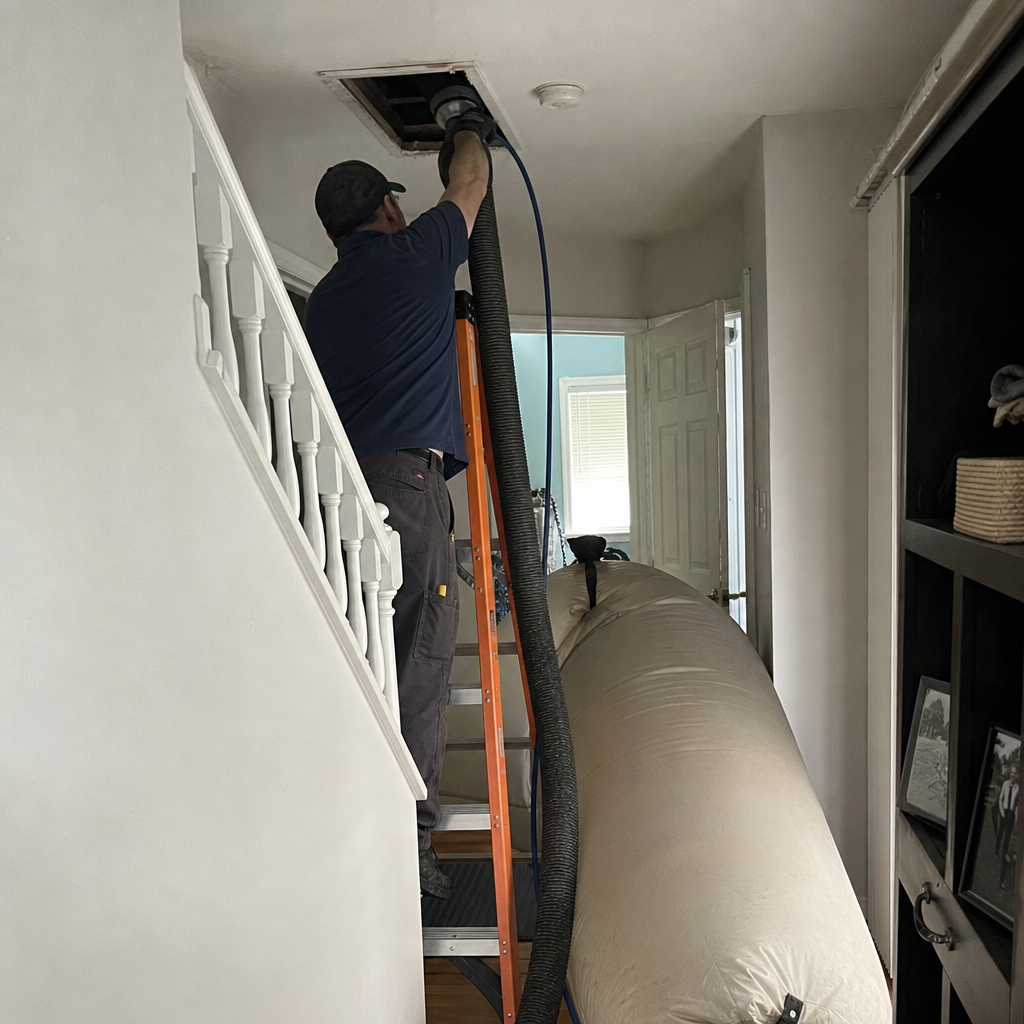
- Negative air establishment. We connect a high-volume vacuum system—either truck-mounted or commercial portable—to create suction throughout the duct network. This negative pressure prevents debris from escaping into your living space during agitation.
- Mechanical agitation and extraction. Using powered brush systems (we run Rotobrush and Nikro equipment), we dislodge adhered debris from duct walls while the vacuum continuously removes it. This isn’t a single pass; it’s methodical section-by-section work.
- Component-level cleaning. The air handler blower wheel, evaporator coil housing, and plenum connections receive targeted attention—these areas collect the densest buildup and directly impact airflow efficiency.
- Post-cleaning verification. We document results with inspection camera footage and measure airflow improvements where accessible.
Anything less than this sequence—particularly any service that skips the air handler or avoids creating proper negative air—is performing partial work at full price.
Why Equipment Makes the Difference: Truck-Mounted vs. Portable Systems
The equipment a technician rolls to your door tells you most of what you need to know about the service you’re actually buying. This distinction matters enormously in Dayton, where we see everything from 1920s bungalows in Oregon District to mid-century ramblers in Riverside with complex duct layouts.
Truck-mounted negative air machines generate 10,000–15,000 CFM (cubic feet per minute) of suction power from gasoline-powered vacuum systems housed in a service vehicle. These are the standard for commercial duct cleaning and legitimate residential specialists. The power allows simultaneous cleaning of multiple trunk lines and maintains consistent negative pressure even in larger Dayton homes—particularly the 2,500+ square foot Colonials and Cape Cods common in Oakwood and Kettering. The limitation: the vacuum hose must reach from truck to furnace, which can be challenging in homes with detached garages or limited driveway access.
Commercial portable systems—the Nikro units we deploy—deliver 5,000–8,000 CFM from electric-powered equipment brought inside. These aren’t shop vacs; they’re HEPA-filtered, sealed-system machines designed for contained debris removal. Portables excel in Dayton’s tighter urban lots, multi-story townhomes, and anywhere truck access is impractical. The tradeoff is single-trunk-line cleaning at a time, which extends job duration but doesn’t compromise thoroughness.
What the $99 crews actually use: Consumer-grade shop vacuums with 150–250 CFM, sometimes fitted with cosmetic brush attachments. These machines cannot establish negative air pressure in a duct system. They remove loose surface debris near register openings and leave the remaining 95% of your ductwork untouched. We’ve opened systems “cleaned” by these operators to find packed debris still adhering to duct walls—homeowners paid for theater, not extraction.
The Rotobrush system we use for certain residential applications combines a rotating brush head with vacuum extraction in a single pass tool. It’s particularly effective in flex duct and smaller diameter rigid duct common in Dayton additions and retrofits. But it’s deployed as part of a complete negative-air protocol, not as a standalone solution.
Dayton’s Older Housing Stock: What Pre-1980 Ductwork Hides
Dayton’s housing market carries a distinctive characteristic that directly impacts duct cleaning methodology: approximately 62% of our housing units were built before 1980, according to Census Bureau data. These aren’t abstract numbers—they’re specific material conditions we encounter daily.
Original ductwork in pre-1980 homes presents three distinct challenges:
- Asbestos-containing duct tape and insulation. Through the 1970s, many Dayton builders used woven asbestos tape to seal metal duct joints, and some wrapped ductwork with asbestos-containing insulation. Disturbing these materials without proper containment and abatement protocols creates serious health hazards. We identify these conditions during initial assessment and coordinate with certified abatement contractors when necessary—never attempting removal ourselves.
- Galvanized steel degradation. Original metal ductwork in Dayton’s older neighborhoods—Walnut Hills, Linden Heights, much of Belmont—often shows internal rust scaling where decades of condensation have corroded the zinc coating. This scale breaks free and circulates as reddish-brown dust. Simple vacuuming doesn’t address it; mechanical agitation with appropriate brush stiffness is required, followed by sealant application where metal thinning has occurred.
- Seal failure patterns. Pre-1980 duct systems were typically sealed with water-based duct tape or mastic that degrades over 40+ years. In our experience across Dayton, these failures concentrate at trunk-line reductions and takeoff connections—precisely where airflow velocity changes stress the seals. A cleaning that doesn’t include seal inspection and repair recommendation leaves you with conditioned air leaking into basements and wall cavities.
Dayton’s climate amplifies these issues. Our humid continental pattern—summer highs averaging 85°F with significant humidity, winter lows in the teens—creates repeated expansion-contraction cycles in metal ductwork. The Miami Valley’s clay-heavy soils also contribute to foundation settling that stresses duct connections in slab and crawl space installations. We’ve repaired separated duct segments in West Carrollton and Miamisburg homes where settlement had pulled apart originally tight connections.
Newer construction isn’t immune, but the failure modes differ. Post-2000 flex duct systems suffer crushed or kinked runs from careless installation, while foam-board duct systems can harbor mold in our humid summers if the exterior vapor barrier is compromised. The point: Dayton’s specific housing age distribution demands technicians who’ve worked across these material generations, not crews trained on a single standardized approach.
What Before-and-After Camera Inspections Should Reveal
Documentation separates accountable work from unverifiable claims. After two decades, we won’t clean a system we can’t show you—because the camera reveals what verbal assurances cannot.
A proper inspection protocol includes:
- Pre-cleaning baseline footage. We insert a flexible borescope camera at multiple access points—typically main trunk lines and representative branch ducts—to record debris accumulation, seal condition, and any structural concerns (crushed flex, disconnected joints, pest intrusion). In Dayton’s older homes, we frequently document rust scaling, previous asbestos tape remnants, and construction debris from original build-out that was never removed.
- Real-time cleaning verification. The camera guides our work, confirming brush contact with all duct surfaces and identifying sections requiring additional passes. This isn’t optional quality control—it’s how we know the job is complete.
- Post-cleaning documentation. We return the camera to the same positions, providing dated footage showing debris removal. You should expect to see clean metal surfaces, intact seals, and clear pathways.
What specifically to look for in legitimate documentation:
- Timestamped footage with date and location metadata
- Multiple camera positions—not a single register shot repeated
- Clear debris characterization—fine dust vs. fibrous insulation vs. construction debris
- Structural condition notes—denting, corrosion, separation points
We’ve encountered competitors in the Dayton market who show generic “before” footage from other homes, or who photograph a single dirty register and imply whole-system condition. Request specific documentation tied to your address. A technician with nothing to hide provides it readily.
The Honeywell and Aprilaire air quality monitors we sometimes recommend for post-cleaning verification can also provide particulate count data, though these serve ongoing monitoring rather than immediate job documentation.
Supply Ducts, Return Ducts, and the Air Handler: The Complete Pathway
Perhaps the most common shortcut in budget duct cleaning: treating only the supply side—the ducts that push conditioned air into rooms—while ignoring returns and the air handler. This defeats the purpose of system cleaning, as contaminants simply recirculate from the unaddressed portions.
Supply ducts carry heated or cooled air from the furnace or air handler to your rooms. They’re typically under positive pressure and accumulate debris that bypasses your filter. In Dayton homes with original construction, supply trunks often run through unconditioned attics or crawl spaces, where temperature differentials create condensation that binds dust to duct walls.
Return ducts pull air back to the air handler for reconditioning. These are under negative pressure and typically accumulate more debris—particularly in homes with standard 1-inch pleated filters that don’t capture fine particulates. Return ductwork in Dayton’s older homes often runs through wall cavities framed as panned joists or stud bays, creating irregular surfaces where debris packs tightly. We’ve extracted decades of accumulated material from wall-cavity returns in East Dayton homes where no previous cleaner had attempted access.
The air handler—blower wheel, evaporator coil, and plenum connections—is where system efficiency lives or dies. The blower wheel’s curved blades collect debris that throws off balance and reduces airflow; even 1/16 inch of buildup measurably impacts performance. The evaporator coil, when dirty, insulates the refrigerant tubes and forces longer cooling cycles—directly increasing summer electric bills in Dayton’s humid climate.
A complete cleaning addresses all three components as an integrated system. Skipping any portion allows recirculation of contaminants and leaves efficiency gains unrealized. When we quote a job, we specify which components are included; anything less than full pathway coverage should prompt hard questions.
How to Read a Quote: What’s Included vs. What’s Upsold
The $99 special thrives on opacity. By the time you’ve navigated the upsell sequence—sanitizing extra, register cleaning extra, air handler extra, returns extra—you’re often at legitimate pricing without legitimate service. Here’s how to read a Dayton duct cleaning quote with the skepticism it deserves.
Line items that should appear in any complete quote:
| Service Component | Typical Dayton Market Range | Red Flag if Absent or Vague |
|---|---|---|
| Supply duct cleaning (all branches) | Included in base | “Per register” pricing |
| Return duct cleaning (all branches) | Included in base | Listed as optional add-on |
| Air handler / blower cleaning | $75–$150 if separate; often included | Not mentioned |
| Register / grille cleaning | Included in base | Extra charge per unit |
| Sanitizing / antimicrobial treatment | $100–$250 if separate | Performed without disclosure of product |
| Basic seal inspection | Included in base | No mention of seal condition |
| Before/after documentation | Included in base | Not offered or extra charge |
Questions to ask any Dayton duct cleaner:
- “Does your quote include both supply and return ductwork, or are returns extra?”
- “What specific equipment do you use—model names, not just ‘professional vacuum’?”
- “Will I receive dated before-and-after footage of my actual system?”
- “What sanitizing product do you apply, and is it EPA-registered for HVAC use?”
- “Are you the person performing the work, or do you subcontract to other technicians?”
That final question matters particularly in Dayton’s market, where national franchise operations dispatch varying technicians with varying training. At Titan Air Duct Cleaning Greater Dayton home, Thomas Hernandez—the owner—performs every job personally. The quote you receive reflects actual hands-on assessment, not a call-center estimate calibrated to book appointments.
Sanitizing deserves specific attention. Legitimate antimicrobial application uses EPA-registered products applied after mechanical cleaning removes organic debris the product would otherwise bind to. We work with Abatement Technologies and Guardsman products appropriate for HVAC systems—never generic “fogging” with undisclosed chemicals. The application should be specified in your quote, not sprung as a health-pressure upsell mid-job.
Common Mistakes to Avoid
- Hiring based on price alone. The $99 coupon special in Dayton typically covers 30 minutes of register-vacuuming with equipment that cannot access your actual ductwork. We’ve re-cleaned systems “serviced” by these operators where the trunk lines remained fully packed. Budget for legitimate work once rather than paying twice for theater.
- Ignoring return ductwork. Many homeowners focus on supply registers because they’re visible, but return ducts typically accumulate more debris and directly impact what reaches your filter. A quote that doesn’t specify return cleaning isn’t quoting complete service.
- Scheduling cleaning without addressing underlying issues. In Dayton’s pre-1980 housing, duct cleaning without seal inspection often means recleaning in 2–3 years. Significant leakage points should be identified and repaired; otherwise, your system continuously pulls unfiltered air from attics, crawl spaces, and wall cavities.
- Accepting verbal scope without written documentation. The specifics matter: number of registers, square footage covered, components included, products used. Dayton’s market includes operators who verbally promise comprehensive service while contracts specify minimal work. Read before signing.
- Neglecting dryer vent cleaning in the same service window. Your dryer vent is part of the same air pathway ecosystem. Lint accumulation creates fire hazards and reduces dryer efficiency—particularly relevant in Dayton’s older homes where original dryer vents may run through inaccessible wall cavities. Dryer Vent Cleaning in Dayton is often efficiently combined with duct cleaning.
- Assuming new construction is clean. We’ve extracted construction debris—drywall dust, wood particles, insulation scraps—from Dayton new builds where the HVAC ran during construction without filtration. “New” doesn’t mean “clean.”
- Skipping HVAC system cleaning. The air handler, evaporator coil, and condensate drainage are integral to system performance. HVAC Cleaning in Dayton addresses these components specifically, often in conjunction with duct cleaning for complete pathway restoration.
When to Call a Professional
Certain conditions warrant immediate professional assessment rather than watchful waiting. Visible mold growth inside ductwork or on components—often appearing as dark spotting near condensate pans or on insulation—requires identification and remediation protocol. Persistent musty odors when the system runs, particularly in Dayton’s humid summer months, suggest biological growth or standing water in the drainage system. Uneven heating or cooling across rooms often indicates blocked ducts, disconnected runs, or blower wheel imbalance. After any renovation involving drywall, flooring, or significant dust generation, debris has entered your system and should be evaluated for removal.
If your home was built before 1980 and has never had professional duct assessment, the probability of seal degradation, possible asbestos-containing materials, and accumulated debris warrants inspection regardless of visible symptoms. Similarly, if you’ve recently purchased a Dayton home with unknown maintenance history, baseline documentation provides reference for future care decisions.
Air Duct Cleaning in Dayton from Titan Air Duct Cleaning Greater Dayton includes this assessment as standard practice—owner Thomas Hernandez personally evaluates every system before recommending scope. We offer free estimates throughout Dayton and surrounding communities; call (866) 834-6947 to schedule.
Frequently Asked Questions
Professional air duct cleaning in Dayton typically ranges from $400 for smaller homes with straightforward access to $900 for larger properties with complex duct layouts or significant debris accumulation. Factors affecting price include total system square footage, number of registers, accessibility of ductwork, and whether additional services like sanitizing or seal repair are needed. Call (866) 834-6947 for a free, specific estimate based on your home’s configuration.
Most Dayton homes benefit from professional duct cleaning every 3–5 years, though several local factors accelerate this timeline. Our humid summers and pollen-heavy springs increase biological and particulate loading; homes with pets, recent renovations, or pre-1980 ductwork often need more frequent service. We assess accumulation during each visit and provide specific recommendations rather than arbitrary schedules. If you can’t recall your last cleaning, you’re likely overdue.
Cleaning removes accumulated allergens—including dust mites, pet dander, pollen, and mold spores—from the surfaces that distribute air throughout your home. For Dayton residents sensitive to our region’s high ragweed and grass pollen counts, this reduction can meaningfully decrease indoor trigger loads. However, duct cleaning is one component of indoor air quality management; filtration upgrades, humidity control, and source reduction complement mechanical cleaning. We sometimes recommend Honeywell or Aprilaire whole-house filtration systems where allergen sensitivity is severe.
Duct cleaning addresses the distribution pathway—supply and return ducts, registers, and grilles. HVAC cleaning targets the mechanical components: blower wheel, evaporator coil, condensate pan, and heat exchanger. These are distinct but interconnected systems; cleaning ducts without addressing a contaminated blower wheel, for example, immediately reintroduces debris. HVAC Cleaning in Dayton from Titan addresses both as an integrated service when needed.
A thorough cleaning of a standard Dayton single-family home requires 2–4 hours of active work. Homes with finished basements limiting access, extensive register counts, or significant debris accumulation may extend toward the longer end. Any service claiming completion in under 90 minutes for a whole-house system is performing partial work. Our process includes setup, mechanical cleaning, component service, documentation, and restoration of access points—each phase requires adequate time.
Sanitizing serves a legitimate purpose when applied correctly: EPA-registered antimicrobial products, applied after mechanical cleaning to sanitized surfaces, address residual biological contamination. It’s not universally necessary—lightly used systems in homes without pets or moisture issues may not warrant it. We recommend sanitizing specifically when inspection reveals mold growth indicators, persistent musty odors, or when occupants have documented immunocompromised conditions. The upsell problem arises when sanitizing is pressure-sold without inspection basis, using generic or unregistered products. We specify product by name—Abatement Technologies and Guardsman formulations in our case—and explain the specific indication for your system.
The Bottom Line
Legitimate air duct cleaning in Dayton is defined by specificity: named equipment, documented processes, component-level scope, and accountable technicians. The $99 coupon economy thrives on obscuring these details, counting on homeowners who can’t distinguish a Rotobrush system from a shop vacuum. After twenty years in Dayton homes—from Oregon District Victorians to Kettering ramblers—we’ve learned that the homeowners who ask hard questions upfront receive the service they actually need. Demand equipment identification, written scope, before-and-after documentation, and direct accountability for who’s performing your work. The ducts in your walls deserve that scrutiny.
Written by Thomas Hernandez, Owner & Lead Technician at Titan Air Duct Cleaning Greater Dayton, serving Dayton since 2006.