
Last updated July 10, 2026
Seasonal Air Duct Cleaning Care for Dayton: Year-Round Homeowner’s Guide
Here’s the counterintuitive truth we’ve learned after two decades in Dayton homes: the worst time to clean your ducts is right after you’ve run the AC all summer and right before you need the heat — and yet that’s when most Dayton homeowners finally think to call. By then, pollen has already baked into your supply lines, summer humidity has turned dust into compacted sludge in your returns, and you’re about to recirculate six months of buildup through every room. In this guide, we’ll walk through what Dayton’s four distinct seasons actually do to your ductwork, when to schedule service for maximum benefit, and why timing your cleaning with your HVAC cycle — not your calendar — protects your air quality and your equipment.
Quick Answer
The optimal air duct cleaning schedule for Dayton runs on two tracks: a late spring cleaning (May–June) to capture peak pollen before cooling season, and a late fall inspection (October–November) to clear summer humidity residue before heating startup. Homes with allergies, pets, or recent renovations may need both, while most Dayton households benefit most from prioritizing the spring window.
Table of Contents
- Spring in Dayton: Pollen, Allergens, and the Critical Pre-AC Window
- Summer Humidity and What It Does Inside Your Ducts
- Fall Cleanup: Leaves, Dust, and Pre-Heating Preparation
- Winter Circulation and Dry Particulate Buildup
- Post-Renovation Cleaning: The Season-Override Rule
- How to Time Professional Service with Your HVAC Tune-Up
- Common Mistakes to Avoid
- When to Call a Professional
- Frequently Asked Questions
Spring in Dayton: Pollen, Allergens, and the Critical Pre-AC Window
Dayton’s tree pollen season typically peaks from late March through mid-May, with grass pollen extending into June. By the time oak, maple, and birch release their peak loads, your return vents have already been pulling that outdoor air through your system for weeks. Here’s what most homeowners miss: once pollen enters your ductwork, it doesn’t simply pass through. It adheres to the existing dust layer on duct walls, gets trapped in filter bypass areas, and accumulates in the dead zones behind elbows and transitions.
When you flip on your AC in late May or early June — which is standard timing for Dayton households — that pollen load gets rehydrated by condensation on your evaporator coil and distributed as a fine, respirable aerosol throughout your home. We’ve pulled supply lines in Kettering and Oakwood homes in July that were still showing March pollen loads in the dust profile.
The late spring cleaning window (May 1–June 15) offers three specific advantages:
- Pollen capture at peak concentration: Your ducts hold the maximum seasonal allergen load right before cooling season starts. Cleaning now removes it before the first AC cycle.
- Dry conditions favor complete debris removal: Spring humidity in Dayton typically stays below 65% until late June, which means dust and pollen aren’t yet adhering to duct walls with moisture bonding.
- Pre-cooling system protection: Clean ducts reduce the particulate load hitting your evaporator coil, which improves heat transfer efficiency and reduces the biofilm growth that causes musty startup smells.
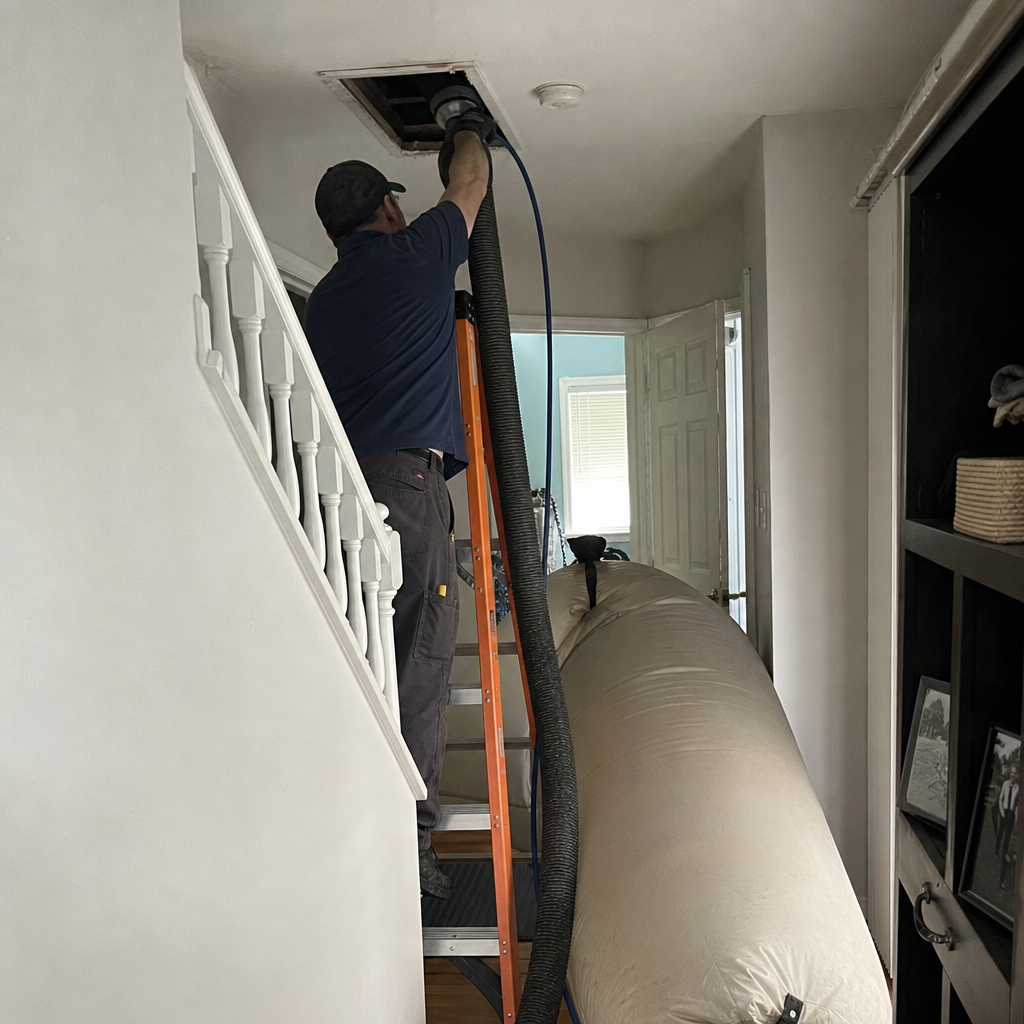
In our experience, Dayton homeowners who schedule during this window report noticeably fewer allergy symptoms through the cooling season and less frequent filter changes. The Rotobrush system we run on every job is particularly effective here — its rotating brush head and concurrent vacuum extraction physically dislodge pollen that’s embedded in fiberglass duct liner, which compressed-air systems often leave behind.
One practical note for Dayton’s older neighborhoods: homes in Grafton Hill, Linden Heights, or the Oregon District with original galvanized ductwork have more surface corrosion that traps pollen mechanically. These systems benefit disproportionately from spring cleaning because the rough surface texture holds more material than smooth modern ducting.
Summer Humidity and What It Does Inside Your Ducts
Dayton’s summer dew point averages climb from June through August, frequently pushing relative humidity above 70% even in conditioned spaces. This humidity doesn’t stay in your living areas — it migrates into your duct system through return leaks, poorly sealed plenums, and the natural pressure differentials that occur when your AC cycles on and off.
Inside your ducts, that moisture does three things simultaneously: it rehydrates dust into a heavier, more adhesive sludge; it creates conditions for mold and mildew growth on organic debris; and it accelerates corrosion in metal components. We’ve opened summer duct systems in Beavercreek and Centerville that showed visible mold spotting on the upstream side of filters where humid return air first contacts accumulated dust.
What to check mid-summer:
- Musty startup smells: If your AC produces a damp odor in the first 10 minutes of operation, you likely have microbial growth on your evaporator coil or in the immediate plenum — both of which connect directly to your duct network.
- Uneven cooling with no airflow obstruction: Humidity-compacted dust in return ducts reduces effective airflow to specific zones without blocking registers entirely.
- Filter loading acceleration: If you’re replacing 1-inch pleated filters faster than every 60 days in summer, your ducts are likely contributing excess debris that’s bonding with humidity.
The critical distinction for Dayton homeowners: summer is generally not the ideal cleaning season, but it’s the essential inspection season. Catching mold conditions in July or August allows remediation before fall heating startup, when those same spores would be dried and distributed as ultra-fine particulate through every heat cycle. Our Nikro HEPA extraction equipment includes UV inspection capability that identifies early mold colonization in fiberglass-lined ductwork — the type common in Dayton homes built between 1970 and 1995.
If you do need summer service, we typically recommend pairing duct cleaning with coil and pan sanitizing using Abatement Technologies products, since the two systems share contamination pathways during humid months.
Fall Cleanup: Leaves, Dust, and Pre-Heating Preparation
Dayton’s fall leaf drop — particularly from the dense maple and sycamore canopies in neighborhoods like Patterson Park and Walnut Hills — creates a unique duct contamination pathway that most homeowners overlook. Your outdoor condensing unit sits at ground level, often surrounded by deciduous trees. When leaves decompose around the unit, they release fine organic particulate that gets drawn through the cabinet and, in systems with any return air pathway leakage, into your ductwork.
More significantly, fall is when Dayton homeowners seal their homes for winter: weatherstripping goes on, windows close, and the natural air exchange that summer provided disappears. Whatever contaminants are in your duct system in October become your entire indoor air profile for the next six months.
The late fall window (October 15–November 30) serves a different purpose than spring cleaning:
- Removes summer humidity residue: The organic debris that grew through humid months gets extracted before heating dries and aerosolizes it.
- Clears leaf and yard debris infiltration: Particularly important for homes with crawl space or basement return plenums that may have drawn outdoor air during fall yard work.
- Prepares the system for continuous recirculation: Winter heating runs more hours per day than summer cooling in Dayton, so duct cleanliness has greater cumulative exposure impact.
We’ve found that Dayton homes with forced-air heating and no humidification system experience significant static electricity and dust circulation issues by January — not because the ducts got dirtier in winter, but because the low humidity of heated air makes existing dust more mobile. A clean duct system going into heating season reduces this effect measurably.
For homes with Aprilaire or Honeywell whole-house humidifiers — which we install and service — fall duct cleaning should precede humidifier activation by at least two weeks. Running a humidifier on dirty ducts is essentially creating a distribution system for whatever bacteria and mold spores are present.
Winter Circulation and Dry Particulate Buildup
Dayton’s winter heating season typically runs from November through March, with January and February bringing the coldest sustained temperatures and lowest outdoor humidity. Your furnace runs longer cycles, your home stays sealed, and your duct system becomes a closed-loop particle accelerator.
The specific winter dynamic in Dayton: cold outdoor air holds minimal moisture, so when your furnace heats that air without adding humidity, relative humidity in your ducts can drop below 20%. At these levels, dust becomes electrostatically charged and highly mobile. It doesn’t settle — it suspends, recirculates, and deposits on the coolest surfaces in your home, which are typically your windows and exterior walls.
What this means for duct maintenance:
- Winter is monitoring season, not cleaning season, for most Dayton homes. The exception: homes with visible dust emission from registers or sudden allergy symptoms that correlate with heating cycles.
- Check your filter monthly — the combination of closed-house conditions and dry, mobile dust loads filters faster than any other season.
- Inspect visible duct runs in unfinished basements for disconnected joints. Winter’s temperature differentials between conditioned and unconditioned spaces create expansion and contraction stress that separates duct seams, pulling unconditioned crawl space or attic air into your system.
In our work across Dayton’s ranch-style homes — common in Belmont and Five Oaks — we see a predictable pattern: winter heating exposes the duct leakage that summer cooling masked. Warm air leaking into a cold basement is more noticeable than cool air doing the same. If you’re feeling drafts near basement ducts or seeing dust streaks on ceiling registers, that’s winter telling you where your system has integrity problems that cleaning alone won’t solve.
We typically recommend winter as the season to schedule duct repair and sealing rather than cleaning, addressing the structural issues that make cleaning less effective year-round.
Post-Renovation Cleaning: The Season-Override Rule
Regardless of what month your calendar shows, there’s one condition that overrides all seasonal scheduling logic: recent construction or renovation work. In Dayton’s active neighborhoods — from the historic rehab projects in South Park to the kitchen and bath updates happening across Washington Township — renovation dust behaves differently than ordinary household debris, and it requires immediate attention.
Construction particulate has three characteristics that make it particularly damaging in ductwork:
- It’s abrasive: Drywall dust, tile cutting residue, and wood sanding particulate are harder and more angular than household dust. They accelerate wear on blower motors and evaporator fins when drawn through the system.
- It’s fine: Renovation dust frequently falls below 2.5 microns — small enough to pass through standard filters and deposit deep in duct branches where cleaning access is limited.
- It’s chemically active: Fresh paint overspray, adhesive residue, and sealant particulates continue off-gassing after deposition in ducts, creating volatile organic compound (VOC) exposure that standard cleaning doesn’t address.
We’ve cleaned duct systems in Dayton homes where renovation completed six months prior, and the dust profile still showed elevated gypsum and silica content — meaning the material had been recirculating continuously. In these cases, we use our Rotobrush system with specialized contact heads for the initial mechanical removal, followed by air quality sanitizing with Guardsman products to address any residual chemical loading.
The season-override rule is simple: If you’ve had significant renovation work — defined as any project that required cutting, sanding, or demolition inside your thermal envelope — schedule duct cleaning within 30 days of project completion, regardless of season. Then resume your normal spring/fall cycle the following year.
This is particularly important for Dayton’s older housing stock, where renovation often involves disturbing lead paint or asbestos-containing materials. Even with proper abatement, residual particulate finds its way into duct systems that weren’t actively sealed during work.
How to Time Professional Service with Your HVAC Tune-Up
One of the most common scheduling mistakes we see in Dayton is homeowners treating duct cleaning and HVAC maintenance as independent events. They’re not — they’re sequential steps in the same system care process, and the order matters significantly.
The correct sequence depends on season:
| Season | First | Second | Why This Order |
|---|---|---|---|
| Spring | Duct cleaning | AC tune-up | Clean ducts prevent new debris from immediately loading the serviced coil and blower |
| Fall | Heating system tune-up | Duct cleaning | Tune-up identifies heat exchanger or burner issues; cleaning follows without recontaminating |
The spring sequence is particularly important. We’ve arrived at Dayton homes where the HVAC technician had just completed a meticulous coil cleaning, only for our duct cleaning to pull six months of accumulated debris through the newly clean system. When we clean first, your AC tune-up starts with clean air pathways and ends with protected components.
For fall, the reverse applies: your heating technician needs to inspect the heat exchanger, test combustion, and verify safeties without ductwork contamination obscuring readings. Once that’s complete, we clean the ducts without disturbing the precision work your HVAC technician just performed.
Practical coordination: most Dayton HVAC companies schedule tune-ups 2–4 weeks out in peak season. We recommend booking your duct cleaning and HVAC service simultaneously, then sequencing them 3–5 days apart. Titan Air Duct Cleaning Greater Dayton coordinates directly with several local HVAC companies on timing — call (866) 834-6947 and we can align schedules.
Common Mistakes to Avoid
- Cleaning right before you sell: Dayton buyers increasingly request pre-sale duct inspection. A cleaning six months prior shows as maintenance; a cleaning the week before listing reads as masking a problem. Time your cleaning for living in the home, not staging it.
- Ignoring the dryer vent: Spring and fall are also peak seasons for dryer vent buildup in Dayton, when heavier fabrics and higher humidity combine to load lint faster. Dryer vent cleaning should run on the same schedule as duct cleaning, not as an afterthought.
- Scheduling during active pollen season: Cleaning ducts in mid-April, when Dayton’s tree pollen is still peaking, means your system recontaminates within days of service. Wait for the pollen count to trend down — typically after Mother’s Day.
- Treating all rooms equally: Bedrooms and home offices typically need more frequent attention than formal living spaces because of higher occupancy hours and textile loading (bedding, curtains, upholstery). Direct more cleaning focus to high-occupancy zones.
- Skipping the inspection: Some Dayton homeowners request cleaning without understanding what their ducts contain. A proper pre-cleaning inspection — which we perform on every job — identifies disconnected ducts, mold conditions, or asbestos tape that changes the service approach entirely.
- Expecting cleaning to fix HVAC problems: Weak airflow, temperature imbalance, and short-cycling are equipment or design issues, not cleanliness issues. Clean ducts improve air quality; they don’t repair undersized returns or failed blower motors.
When to Call a Professional
Some duct conditions require immediate professional assessment regardless of your scheduled maintenance calendar. Call for service if you notice visible mold growth on registers or in visible duct runs, persistent musty odors that correlate with system operation, sudden increases in dust emission from supply vents, or airflow reduction that’s not explained by filter condition. In Dayton’s humid summer climate, these symptoms can escalate from minor to significant within a single season.
Titan Air Duct Cleaning Greater Dayton offers free estimates in Dayton and surrounding communities — call (866) 834-6947. Your owner is your technician: Thomas Hernandez personally leads every job, bringing two decades of hands-on experience and professional-grade Rotobrush and Nikro equipment to every home.
Frequently Asked Questions
Most complete residential duct cleaning projects in Dayton range from $400 to $800 for a standard single-system home, with larger homes or systems with multiple zones running higher. Factors that affect pricing include the number of supply and return vents, whether your system includes fiberglass-lined ductwork that requires specialized contact cleaning, and whether dryer vent or HVAC cleaning is bundled with the service. Call (866) 834-6947 for an exact quote — estimates are free and include a full inspection.
Yes, duct cleaning can be performed in winter, though it’s generally less optimal than spring or fall scheduling. Winter cleaning in Dayton requires managing the thermal shock to your system — we use contained extraction methods that minimize heat loss during service, and we sequence the work to restore heating quickly. However, winter is typically better suited to duct repair and sealing, with cleaning deferred to the next spring window if the system isn’t actively problematic.
The standard recommendation for Dayton homes is every 3 to 5 years for basic maintenance, with annual inspection to assess actual conditions. Homes with pets, allergies, smokers, or recent renovations should consider more frequent service — every 2 to 3 years. The specific interval depends on your home’s air exchange rate, filter quality, and occupancy patterns, which is why we perform a visual assessment before recommending any service schedule.
Repair is typically more cost-effective for isolated damage — disconnected joints, small sections of corroded metal, or damaged flex runs — with repairs often running $200 to $500 per section. Full duct replacement becomes the better economic choice when your system shows widespread deterioration, original asbestos-containing materials, or design flaws that repairs can’t address. In Dayton’s older neighborhoods with original galvanized ductwork, we frequently recommend targeted repair and sealing to extend system life without full replacement. Call (866) 834-6947 and we’ll inspect and advise on the specific economics for your home.
May and early June offer the best combination of conditions: pollen season is tapering, summer humidity hasn’t yet peaked, and you’re cleaning before the heavy AC usage that will recirculate any remaining debris. October and November serve as the secondary optimal window for homes that also need pre-heating preparation. Avoid mid-March through mid-April, when Dayton’s tree pollen load is actively entering your system.
Look for these specific indicators: visible dust accumulation on register fins and surrounding ceiling areas, filters that load faster than manufacturer specifications, musty or stale odors when your system cycles on, and increased allergy symptoms that correlate with time spent indoors. One practical test: remove a supply register and photograph the duct interior with your phone. If you see more than a light dust coating on the visible surfaces, the hidden ductwork is significantly more loaded. For a definitive assessment, professional inspection with camera equipment reveals conditions in branches you can’t access.
The Bottom Line
Dayton’s four-season climate creates distinct contamination patterns in your ductwork, and timing your cleaning to match those patterns delivers better results than any arbitrary annual schedule. Prioritize late spring to capture pollen before cooling season, use late fall to clear humidity residue before heating startup, and override both schedules immediately after any renovation work. Pair your cleaning with appropriately sequenced HVAC maintenance, and treat duct repair needs as separate from — but complementary to — cleaning service. Your indoor air quality isn’t a single-event fix; it’s a system that responds to how you time the care you give it.
Written by Thomas Hernandez, Owner & Lead Technician at Titan Air Duct Cleaning Greater Dayton, serving Dayton since 2006.