
Is Air Duct Cleaning Worth It in Dayton, OH? For Most Local Homes, It’s Overdue Maintenance
Yes — for the majority of Dayton homeowners, especially those in mid-century housing with original ductwork, air duct cleaning is worth it because decades of accumulated debris, Miami Valley humidity, and aging sheet-metal systems create conditions that routine HVAC maintenance alone cannot address. The national debate about whether duct cleaning provides measurable benefit assumes a baseline of relatively clean, modern systems; in Dayton, where much of the housing stock dates to the 1950s and 1960s and has never been professionally cleaned, the question isn’t whether cleaning helps, but whether anyone can claim the system is already clean. If you’re unsure about your home, call Titan Air Duct Cleaning Greater Dayton at (866) 834-6947 for a free, no-pressure assessment.
The EPA’s “Limited Evidence” Warning Wasn’t Written for a 1963 Kettering Ranch
The Environmental Protection Agency’s frequently cited position — that duct cleaning has not been proven to prevent health problems — applies to average housing conditions nationwide. It was not written with Dayton’s specific housing stock in mind.
Consider what we regularly encounter in Kettering, Huber Heights, and the inner-ring neighborhoods that surround downtown Dayton. A 1963 ranch with original sheet-metal returns, ductwork that has never been opened, and perhaps one or two furnace replacements that never included a full system cleaning. The debris we pull from these systems isn’t a light coating of household dust. We’re talking about compacted layers of particulate that have accumulated across six decades — construction debris from the original build, decades of skin cells and textile fibers, pet dander from multiple generations of animals, and in many cases, evidence of rodent activity that homeowners never knew about.
Thomas Hernandez, our owner and lead technician, grew up in Dayton’s Belmont neighborhood and learned the mechanical side of HVAC systems through Sinclair Community College’s HVAC/R program before focusing entirely on ductwork. He’s been inside enough local homes to know that the “average” national standard doesn’t apply here. When he opens a plenum in a Huber Heights ranch and finds the original 1958 insulation crumbling into the airstream, the EPA’s general guidance about “limited evidence” doesn’t address what he’s looking at.
That said, we’ll give you the straight answer: if your home was built in the last decade, has modern flex-duct with sealed returns, and shows no signs of contamination, the evidence for routine cleaning is genuinely thin. We don’t sell jobs that don’t need doing. But that’s not the typical Dayton home, and pretending it is does a disservice to homeowners who are breathing air through systems that have never been properly serviced.
Dayton’s Housing Stock Changes the Entire Calculation
The Miami Valley’s residential base is dominated by housing built during the city’s industrial manufacturing peak — the 1940s through 1960s — much of it now aging with original ductwork that has rarely if ever been professionally cleaned. This isn’t a small segment of the market; it’s the defining characteristic of local housing.
In Huber Heights, one of the largest planned communities of all-brick single-family homes in the United States, developer Charles Huber built thousands of nearly identical homes in the 1950s and 1960s. The concentration is remarkable: nearly every home on a given street shares the same construction year, the same developer, and the same ductwork configuration. When our technician learns the quirks of one 1958 Huber ranch — the undersized return chases, the interior soffit runs prone to rodent intrusion — he essentially knows the layout for the entire block.
This creates a duct-cleaning demand profile that newer-growth markets simply don’t have. Columbus, with its boom of 1990s and 2000s construction, has a fundamentally different baseline. In Dayton, the question “is air duct cleaning worth it” needs to account for:
- Original sheet-metal ductwork in Kettering, Huber Heights, and inner-ring neighborhoods — rigid metal that doesn’t flex or self-clean, with seams that collect debris across decades
- Gravity furnace conversions in older pre-WWII areas like South Park and Five Oaks, where octopus furnaces were replaced with forced-air systems, leaving oversized, uninsulated trunk ducts that accumulate far more debris than modern systems and require significantly more time and equipment to clean properly
- Never-serviced systems — the norm, not the exception, in homes that have changed hands multiple times without duct cleaning ever appearing on a maintenance checklist
When the baseline is six decades of accumulated debris rather than a few years of normal use, the “is it worth it” question looks fundamentally different. You’re not debating a marginal wellness upgrade; you’re assessing whether deferred maintenance has reached a point that affects system performance and indoor air quality.
The Miami Valley Humidity Factor You Won’t Read About in National Guides
Here’s something the generic “is duct cleaning worth it” articles never address: Dayton sits in a river-valley bowl formed by the Great Miami and Mad Rivers, a topography that traps humidity more intensely than flatter surrounding terrain. This isn’t abstract meteorology — it’s a mechanical reality inside your ductwork.
That above-average ground-level moisture infiltrates older, uninsulated ductwork through condensation. We’ve opened systems in Oakwood and Beavercreek where the interior sheet metal was visibly wet during summer months, creating conditions for microbial growth that simply don’t exist in drier, flatter markets. The national duct-cleaning skepticism largely originates from researchers in arid western climates or flat midwestern plains where humidity management is a different challenge entirely.
This distinction matters because it affects what “clean” means. A dry system with inert dust is different from a humid system with active biological growth. Our Rotobrush and Nikro equipment — the same brush-and-vacuum systems used by commercial contractors — is specifically designed to address both the particulate accumulation and the microbial conditions that Dayton’s climate creates. We pair mechanical cleaning with air quality sanitizing using products from Abatement Technologies and Guardsman when the situation calls for it, not as a routine upsell but as a targeted response to what we find.
Three Situations Where Cleaning Is Clearly Worth It — Regardless of the National Debate
After two decades in Dayton homes, we’ve identified three scenarios where the question isn’t whether cleaning is worth it, but how quickly it can be scheduled:
Visible debris at registers. If you’re seeing dust plumes when the system kicks on, or if register covers show dark accumulation, the debris inside the ductwork is significantly worse. What reaches the register is what the airflow can carry; what’s lodged in the trunk lines and plenum is typically far more substantial.
Confirmed rodent intrusion in return ducts. This is particularly common in older Dayton-area homes with soffit runs and crawl space connections that have developed gaps over decades. We find evidence of mice and chipmunk activity in returns more often than homeowners expect. This isn’t a cleaning preference — it’s a sanitation necessity, and it requires professional equipment to address properly.
Post-renovation with disturbed insulation or drywall dust. Dayton’s active historic renovation market means we’re regularly called to homes in neighborhoods like St. Anne’s Hill or Walnut Hills where walls have been opened, plaster removed, and original insulation disturbed. That debris doesn’t stay in the work zone; the HVAC system pulls it into the ductwork and redistributes it throughout the home until it’s properly cleaned.
In each of these cases, the national “limited evidence” discussion is irrelevant. The system is demonstrably contaminated, and the only question is whether you address it or continue circulating that contamination through your living space.
What Honest Assessment Looks Like — And Why It Matters
Our 113 verified reviews at a 4.7 rating weren’t built by selling every homeowner a full cleaning. Thomas Hernandez’s approach — and this is where the owner-as-technician model makes a real difference — is to show you what we find and tell you straight whether it needs addressing.
We’ve done assessments in newer Centerville homes where the flex-duct was clean, the returns were sealed, and we told the homeowner to spend their money elsewhere. That honesty costs us a job in the moment, but it builds the reputation that keeps the phone ringing. Thomas’s view is simple: “If I wouldn’t leave it in my own ducts, I’m not leaving it in yours.” That cuts both ways — we don’t clean what doesn’t need cleaning, and we don’t leave contamination that does.
This matters because the duct cleaning industry has a reputation problem. Franchise dispatchers and coupon crews — the ones who offer $79 whole-house specials — have trained homeowners to expect high-pressure sales and bait-and-switch pricing. When you call Titan, you’re talking to Thomas or his direct team. The person who answers your questions is the person who’ll be in your home with the equipment. There’s no call center, no commissioned sales closer, no incentive to sell you something you don’t need.
What Professional Duct Cleaning Actually Involves — And What It Costs in Dayton
For homeowners who’ve decided the service is worth exploring, here’s what the process looks like and what you can expect to invest, including our guide to How Much Does Air Duct Cleaning Cost? (2026 Price Guide) — Dayton, OH.
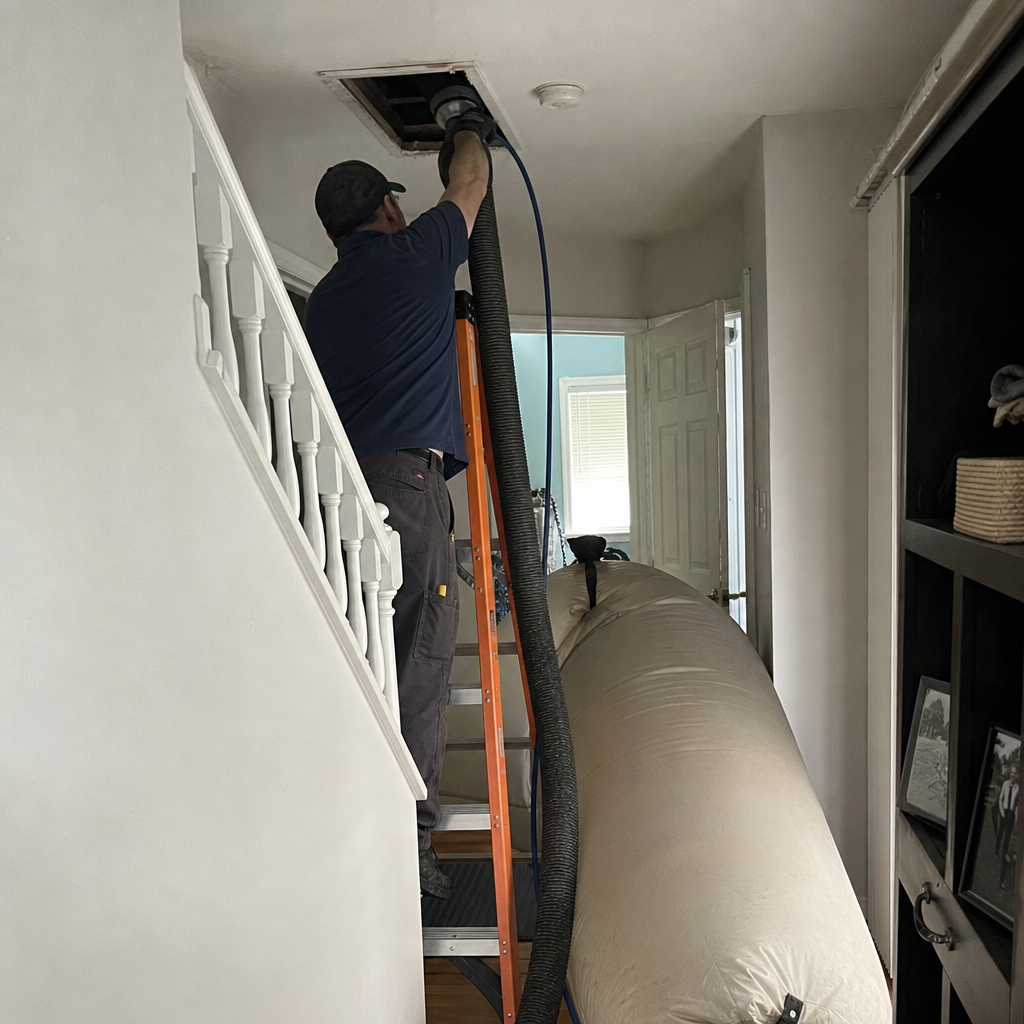
Our Air Duct Cleaning service uses Rotobrush and Nikro equipment — commercial-grade brush-and-vacuum systems that agitate debris from duct walls while simultaneously extracting it under negative pressure. This isn’t a shop vac with a long hose; it’s equipment designed specifically for residential and light commercial ductwork, with brushes sized for different duct diameters and HEPA filtration on the vacuum side.
For a typical Dayton home — think a 1,200–2,200 square foot ranch or split-level with 8–12 registers — Whole House Air Duct Cleaning Cost in Dayton, OH covers a process that takes 3–5 hours and addresses:
- Supply and return trunk lines
- Branch ducts to each register
- Furnace plenum and evaporator coil access (where reachable)
- Register and grille cleaning
- System sanitizing when microbial growth is present
Pricing in the Dayton market typically ranges as follows:
| Service Component | Typical Range |
|---|---|
| Standard residential duct cleaning (single system, 8–12 registers) | $350 – $550 |
| Larger homes or systems with 13–20 registers | $500 – $750 |
| Gravity furnace conversion systems (oversized trunks, South Park/Five Oaks type) | $600 – $900 |
| Dryer vent cleaning (add-on or standalone) | $125 – $200 |
| Duct repair/sealing (per project, varies significantly) | $200 – $800+ |
| Air quality sanitizing (when indicated) | $75 – $150 |
These are Dayton-market ranges based on our 20 years of local pricing; your exact quote depends on system accessibility, contamination level, and any needed repairs. We provide upfront, itemized estimates before beginning work — no surprises, no post-cleaning add-ons.
For homes with the original ductwork configurations common in Huber Heights or Kettering, the time investment is higher than for modern flex-duct systems, but the results are also more dramatic. We’ve had homeowners tell us they noticed reduced dust accumulation within days, and others who found their allergy symptoms improved after the first season. We don’t promise medical outcomes — that’s not honest — but we do guarantee that the system we leave is mechanically clean, with photographic documentation of before and after conditions.
When Duct Cleaning Might NOT Be Worth It — And We’ll Tell You
We want to be as specific about when not to call us as when to call. Here’s where we’d steer you away from the service:
Your home is under 10 years old with modern construction. Sealed returns, properly installed flex-duct, and contemporary filtration systems typically don’t accumulate significant debris in that timeframe. Check your filter regularly and save your money.
You’re expecting dramatic health improvements from a single cleaning. If you have serious respiratory conditions, duct cleaning is one component of a broader indoor air quality strategy — source control, filtration, humidity management. We work with Aprilaire and Honeywell products when homeowners want to address the full system, but cleaning alone isn’t a medical intervention.
Your ducts are visibly damaged or deteriorating. Cleaning won’t fix disconnected ducts, collapsed flex, or rusted-out metal. In those cases, we pivot to duct repair and sealing, which is a different service and a different conversation.
This honest assessment is how we’ve maintained our reputation across two decades. Thomas Hernandez’s teenage son started riding along on weekend jobs a few years back, which Thomas says is either proof the trade gets in your blood or proof his kid couldn’t say no to him. Either way, it’s a family business built on repeat customers and referrals, not one-time transactions.
FAQs
For a typical Dayton home with 8–12 registers, Affordable Air Duct Cleaning in Dayton, OH runs $350–$550, with larger homes or older systems with oversized trunk lines ranging $500–$900. Call (866) 834-6947 for a free, exact quote based on your specific system — estimates are always no-pressure.
It can reduce the allergen load circulating through your HVAC system, especially in older Dayton homes where decades of accumulated dust, pollen, and pet dander have built up in original ductwork. We don’t promise medical outcomes, but many customers report reduced symptoms after cleaning, particularly when paired with upgraded filtration. For a personalized assessment of whether your system is likely contributing to allergy issues, call (866) 834-6947.
For Dayton’s mid-century housing stock with original ductwork, every 5–7 years is a reasonable interval given the Miami Valley’s humidity and the age of most local systems. Newer homes with modern construction can often go 10 years or more. The real indicator isn’t the calendar — it’s whether you see debris at registers, notice musty odors when the system runs, or know your system has never been cleaned. Call (866) 834-6947 and we’ll tell you honestly whether yours is due.
Cleaning is almost always the more economical first step — typically $350–$750 versus $3,000–$8,000+ for full duct replacement in a Dayton-area home. Replacement becomes worth considering only when ducts are physically damaged, severely rusted, or improperly sized for the current HVAC system. We assess this during every job and will tell you straight if your money is better spent on replacement. Call (866) 834-6947 for an honest evaluation of your specific system.
Ready to Know What You’re Breathing?
If you’re in a Dayton-area home with original ductwork — especially in Kettering, Huber Heights, or any of the city’s mid-century neighborhoods — the question isn’t whether air duct cleaning is worth it in the abstract. It’s whether six decades of accumulated debris, Miami Valley humidity, and never-serviced sheet metal have reached a point that affects your system and your air. At Titan Air Duct Cleaning Greater Dayton, we’ll show you exactly what we find and tell you honestly whether it needs addressing. No coupon-crew pressure, no upsells for clean systems. Call (866) 834-6947 for a free estimate.
Written by Thomas Hernandez, Owner & Lead Technician at Titan Air Duct Cleaning Greater Dayton, serving Dayton, OH.