
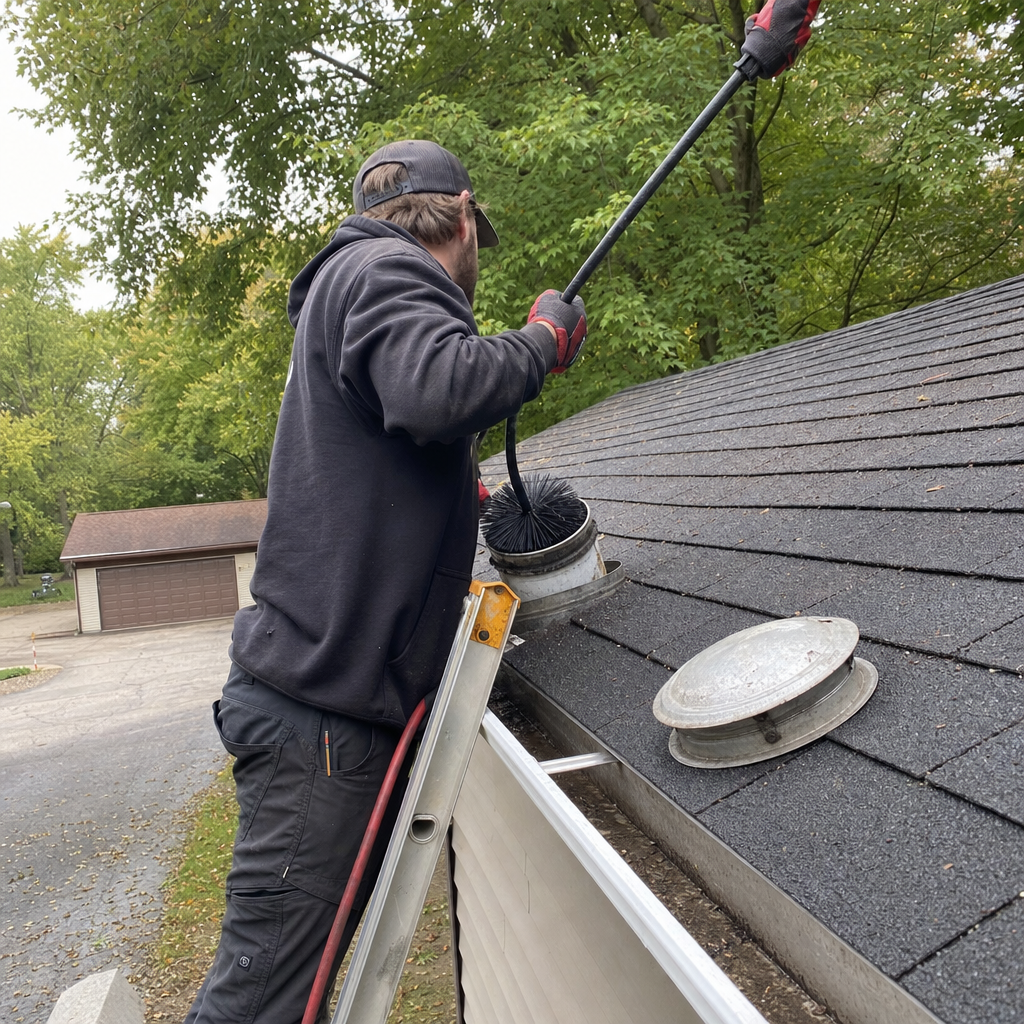
Signs You Need Dryer Vent Cleaning in Dayton, OH
The single most reliable sign you need dryer vent cleaning is a load of laundry that takes two full cycles to dry while the drum itself feels unusually hot — this combination almost always means your vent line is blocked with lint, not that your heating element is failing. In Dayton’s mid-century ranch neighborhoods, where interior utility rooms force vent lines through 25 feet of finished wall or attic space, this symptom often appears months before any visible warning at the exterior cap. If you’re running your dryer twice and still finding damp towels, call (866) 834-6947 — we’ll diagnose it over the phone and schedule Affordable Dryer Vent Cleaning in Dayton, OH if that’s what it is.
Why a Hot Drum with Slow Drying Points Straight to the Vent
We’ve been in thousands of Dayton homes over two decades, and the pattern never changes: homeowner calls an appliance tech, pays for a heating-element inspection, gets told the dryer is fine, then finally calls us. The dryer is fine. It’s suffocating.
Here’s what actually happens. Your dryer’s heating element reaches its set temperature, but the moist air has nowhere to go. The humidity stays in the drum, the thermostat keeps the element cycling longer, and the drum gets hot to the touch while your clothes stay damp. The dryer works harder, your electric bill climbs, and the excess heat backs up into the appliance’s own cabinet.
In a standard side-exit installation — common in newer construction — you might notice weak airflow at the exterior cap and connect the dots yourself. But Dayton’s housing stock doesn’t cooperate that way. The mid-century ranches in Kettering, the Huber Heights brick homes built by Charles Huber’s crews in the 1950s and 60s, the split-levels throughout the city’s inner-ring neighborhoods — these were designed with utility rooms centered in the floor plan, which means the vent line travels through wall cavities, soffits, or attic spaces before reaching daylight. You can’t see it. You can’t reach it. And a consumer-grade brush kit that extends twelve feet stops well short of the blockage.
Our Dryer Vent Cleaning in Dayton uses Nikro extraction equipment specifically because it handles full line lengths with multiple bends — the reality in most Dayton homes we service.
The Hidden-Route Problem in Dayton’s Ranch Housing
The Dayton market has a diagnostic challenge that newer-growth cities simply don’t face. When we pull up to a Huber Heights ranch built in 1958, we already know the layout: interior utility room, vent line routed through a finished basement soffit or up through a first-floor wall, two or three 90-degree bends to navigate structural framing, and an exit point somewhere on the rear roofline or through a side wall well away from the laundry area.
This matters because the standard homeowner test — “go outside and feel if air’s coming out” — tells you almost nothing useful. Air might be coming out. It might even feel warm. But a partial blockage still lets some air through while trapping the majority of lint, moisture, and heat in the line. We’ve cleared vents where the exterior cap had visible airflow yet the line was 70% obstructed twenty feet inside the wall. The homeowner had no idea until the dryer started failing its thermal cutoff and shutting down mid-cycle.
Partial blockages are, in some ways, more dangerous than full ones. A completely blocked vent triggers the dryer’s thermal safety switch and stops the cycle. A partial blockage lets the dryer keep running while superheated, lint-laden air pressurizes the vent line and seeks any gap, seam, or compromised joint. In an older home with original foil or plastic transition duct behind the dryer, that pressure finds weak points. We’ve seen scorched wall framing and melted transition hoses in Dayton’s older neighborhoods — always from partial, not full, blockages that went unaddressed.
Dayton-Specific Signs the Generic Articles Miss
Most “signs you need dryer vent cleaning” lists repeat the same five bullet points. Here are the failure modes we actually encounter in Dayton’s specific housing stock and climate.
- Bird or rodent nests at the exterior cap. Older Dayton homes often still have original vent termination hardware — simple flapper caps or louvered covers without proper pest guards. In our humid Miami Valley climate, these deteriorate faster than in drier regions, creating gaps that sparrows and mice exploit. A nest-blocked cap presents identically to an internal lint blockage: slow drying, hot drum, longer cycles. The difference is that lint clearing won’t fix it, and the nest typically sits right at the cap where Dayton’s older hardware offers no barrier.
- Condensation staining on interior walls near the vent path. Dayton’s river-valley geography traps ground-level humidity more intensely than flatter Ohio markets. When a partially blocked vent line can’t exhaust moist air efficiently, that moisture condenses inside cooler wall cavities — especially in uninsulated runs common in mid-century construction. We’ve found water-stained drywall in Kettering ranches where the homeowner assumed they had a roof leak; it was a blocked dryer vent saturating the wall cavity with humid exhaust.
- Musty odor in the laundry area that persists after cleaning the washer. Trapped lint holds moisture. In Dayton’s above-average humidity, that moisture breeds microbial growth inside the vent line itself — not dramatic mold, but enough to produce a persistent damp-wool smell that no amount of washer cleaner resolves. This is particularly common in homes with longer vent runs where airflow has been compromised for months.
- The “one more cycle” habit that creeps in gradually. This is the diagnostic sign homeowners dismiss longest. You didn’t suddenly start needing two cycles; you slowly adjusted your expectations. First it was heavy towels. Then jeans. Then everything. By the time you’re running the dryer twice for a standard load, the vent has been significantly blocked for weeks or months. We hear this story constantly in Dayton’s older neighborhoods where the vent path is hidden and the decline is invisible.
Common Local Scenarios We See in Dayton Homes
Every market has its patterns. In Dayton, these three scenarios account for most of our Best Dryer Vent Cleaning in Dayton, OH calls — and each carries lessons about what to watch for in your own home.
The Huber Heights Ranch with the Roof-Exit Vent
Nearly every home on a given Huber Heights street shares the same build year, same developer, same ductwork configuration. A technician who learns the quirks of one 1958 Huber ranch essentially knows the layout for the entire block. The typical dryer vent here exits through the roof — a 20-plus foot vertical run with at least two bends. Homeowners rarely realize this until we show them the routing on our inspection camera. Lint accumulates at the low points and bends, and the vertical run means gravity works against you; loose lint settles rather than blowing through. Our Rotobrush system with reverse-skipper ball agitation is specifically designed to dislodge this settled accumulation and extract it with negative air pressure — not push it deeper, which is what happens with consumer brushes.
The Kettering Split-Level with the Interior Utility Room
Split-levels in Kettering and similar Dayton suburbs often tuck the laundry into a central closet or half-basement room with no exterior wall access. The vent line runs through a finished basement soffit, makes a 90-degree turn at the main beam, then travels another fifteen feet to a side-wall exit. We’ve found original 1960s installations still using 3-inch diameter vent pipe — undersized by modern code and far more prone to lint accumulation than the 4-inch standard. These homes also tend to have original transition ducts behind the dryer: crumpled foil or sagging plastic that creates an immediate blockage point. We replace these with rigid or semi-rigid metal transitions as part of our cleaning service — not because we’re upselling, but because leaving a crushed foil duct in place undoes the cleaning in six months.
The South Park or Five Oaks Conversion with the Gravity Furnace Legacy
In Dayton’s older pre-WWII neighborhoods like South Park and Five Oaks, gravity (octopus) furnaces were converted to forced air decades ago, leaving behind oversized, uninsulated trunk ducts. While this primarily affects the HVAC system, it creates a basement environment that’s unusually dusty and debris-laden — and that dust migrates into the laundry area, where the dryer’s intake pulls it through the appliance and into the vent line. These homes also tend to have more basement moisture issues from foundation age, which means lint in the vent line clumps and adheres to pipe walls rather than flowing freely. We’ve pulled out vent blockages in these neighborhoods that were essentially felted mats of lint and dust, hardened by repeated humidity cycling.
What Happens During Professional Dryer Vent Cleaning
We approach this as a diagnostic job first, cleaning job second. Thomas Hernandez, our owner and lead technician, starts every dryer vent service with a airflow measurement at the exterior cap — this gives us a baseline and often reveals whether the blockage is at the cap, in the line, or at the transition duct behind the dryer.
From there, we use Nikro extraction equipment with HEPA containment to agitate and remove lint from the full line length. For the longer, multi-bend runs common in Dayton’s mid-century housing, we deploy brush systems sized to the pipe diameter and camera inspection to verify clearing at each bend. The process typically takes 60–90 minutes for a standard residential vent, longer for complex routings or significant accumulation.
We finish with another airflow measurement to confirm we’ve restored proper exhaust velocity, and we inspect the transition duct behind the dryer for damage or improper material. If I wouldn’t leave it in my own ducts, I’m not leaving it in yours.
Our Dryer Vent Cleaning service page has full details on scheduling and what to expect.
When to Call vs. When to Check Yourself
There are two things any homeowner can safely check: the exterior cap for visible obstruction (lint, nests, damaged flappers) and the transition duct behind the dryer for kinks or disconnections. Do not attempt to disassemble the vent line inside wall cavities, and do not run the dryer with the vent disconnected — this vents carbon monoxide and humid lint directly into your home.
Call us when:
- Drying time has increased gradually over weeks or months
- The drum is hot to touch at cycle end
- You’ve checked the cap and transition duct and the problem persists
- Your vent routing is hidden in walls, attic, or soffit with no visible path
- You smell mustiness or burning odor from the laundry area
- It’s been more than two years since professional cleaning
Dayton’s combination of aging housing stock, humidity-trapping river valley geography, and common interior utility room layouts means most local homes benefit from annual dryer vent inspection and cleaning on a two-year cycle at minimum. See our full breakdown of How Much Does Dryer Vent Cleaning Cost? (2026 Price Guide) — Dayton, OH for pricing details.
FAQs
If the drum gets hot but clothes stay damp, it’s almost always the vent — a failing heating element typically produces no heat at all, or insufficient heat that feels warm rather than hot. We’ve saved Dayton homeowners hundreds in unnecessary appliance service calls just by walking through this distinction over the phone. Call (866) 834-6947 and we’ll help you diagnose it before you schedule anything.
You can clear lint from the exterior cap and check the transition duct behind the dryer, but for the hidden line lengths typical in Dayton’s mid-century ranches and split-levels, professional equipment is necessary to reach and extract blockages without damaging the vent pipe or pushing lint deeper. Consumer brush kits extend 12 feet at most; many Dayton homes have 20–25 foot runs with multiple bends. Our Nikro extraction system handles the full length with controlled agitation and negative air containment.
Every two years for most Dayton homes, annually if you have a longer hidden run, an older home with original vent hardware, or a household that runs multiple loads daily. Dayton’s above-average humidity from the Miami Valley’s enclosed topography accelerates lint clumping and adhesion, which means vents here accumulate faster than in drier markets. Homes in Huber Heights, Kettering, and other mid-century neighborhoods with interior utility rooms and complex routing should lean toward annual service.
Yes — in some ways more dangerous than a full blockage. A completely blocked vent triggers the dryer’s thermal cutoff and stops operation; a partial blockage allows continuous operation while pressurizing the line with superheated, lint-laden air that can escape through gaps and seams. We’ve found scorched wall framing and melted transition hoses in Dayton’s older neighborhoods from exactly this scenario. If your drying time has increased and the drum runs hot, don’t wait for a complete blockage to address it. Call (866) 834-6947 for a no-pressure assessment — estimates are free.
Ready to Get Your Vent Cleared?
If your dryer’s running hot and slow, or you’re not sure whether your hidden vent line is clear, Titan Air Duct Cleaning Greater Dayton offers straightforward diagnosis and thorough cleaning without the upsell pressure. We’ve spent two decades in Dayton’s homes — from the uniform ranches of Huber Heights to the converted gravity systems of South Park — and we know the specific failure patterns this market produces. Call (866) 834-6947 for a free estimate, or visit our home page to learn more about our complete indoor air pathway services.
Written by Thomas Hernandez, Owner & Lead Technician at Titan Air Duct Cleaning Greater Dayton, serving Dayton, OH.