
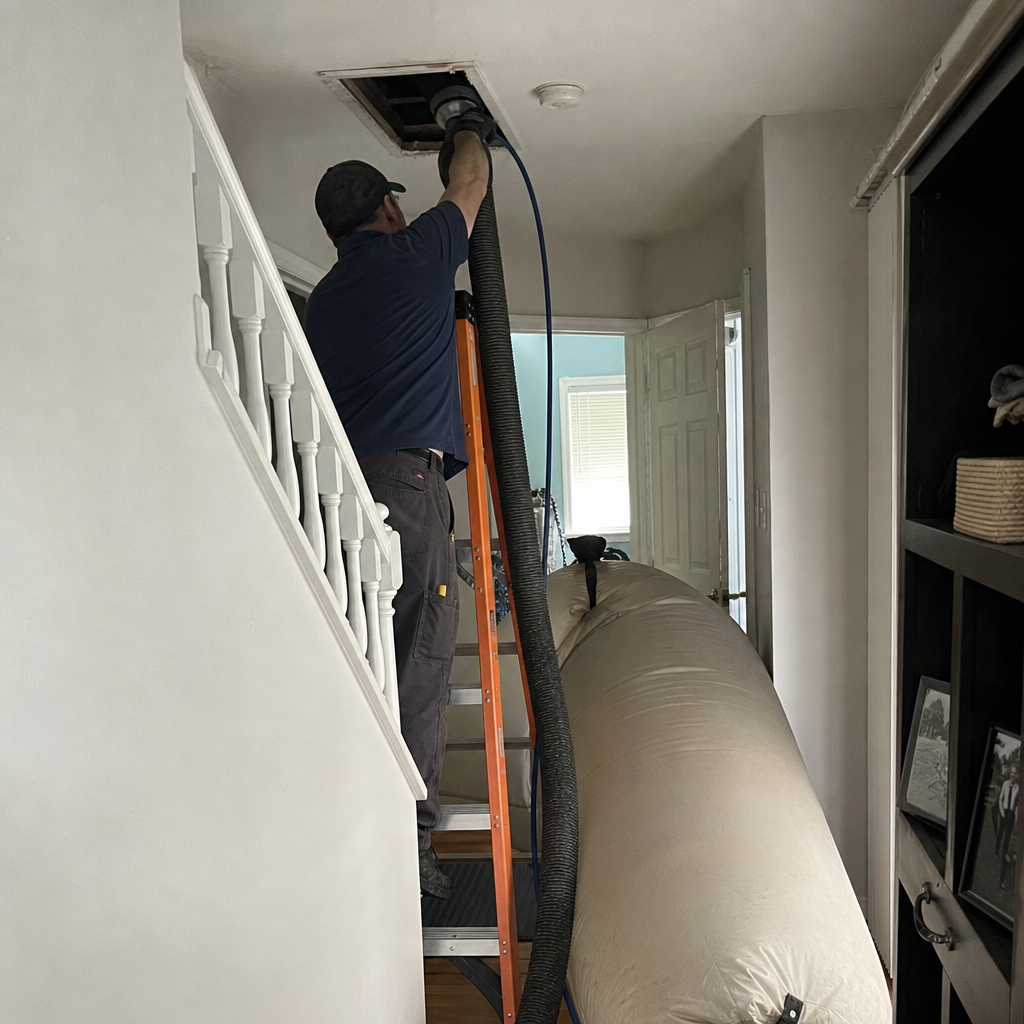
How Often to Clean Air Ducts in Dayton, OH: The Real Interval Depends on Where You’re Starting From
For most homes in Dayton, air duct cleaning is worth doing every 3 to 5 years as maintenance—but if your ductwork has never been professionally cleaned, that recommendation doesn’t apply yet. You’re not on a maintenance schedule; you’re resetting a baseline that’s been accumulating debris for decades. Call (866) 834-6947 for a free assessment of where your system actually stands.
The “Never Cleaned” Problem in Dayton’s Older Housing Stock
Here’s the scenario we walk into more often than not: a homeowner in Kettering or Huber Heights calls asking how often they should clean their ducts, and when we ask when it was last done, the answer is some variation of “never” or “maybe when the furnace was replaced in 1998.” At that point, the 3–5 year rule is irrelevant. You’re not deciding between a 2021 cleaning and a 2026 cleaning. You’re deciding whether to address 40, 50, sometimes 70 years of accumulated buildup in original sheet-metal ductwork that was installed when Harry S. Truman was president.
Thomas Hernandez, our owner and lead technician, grew up in Dayton’s Belmont neighborhood and learned the mechanical side of HVAC systems through Sinclair Community College’s HVAC/R program before focusing entirely on ductwork. He’s spent two decades crawling through the attics and crawlspaces of the Miami Valley, and he’ll tell you straight: the first cleaning in an older Dayton home isn’t maintenance. It’s remediation. We’ve pulled out enough debris from a single 1950s ranch in Huber Heights to fill a shop vacuum drum—compact, layered, often damp from decades of valley humidity working its way into uninsulated runs.
The distinction matters because it changes what you should expect. A maintenance cleaning on a system that’s been kept up every few years takes a few hours and removes moderate dust and allergen load. A first-ever cleaning on original mid-century ductwork is a different job entirely—more time, more equipment, and often the discovery of issues like disconnected joints, rodent intrusion in soffit runs, or microbial growth that humidity has been feeding for years. Our air duct cleaning service is structured for both scenarios, but we price and scope them honestly based on what we’re actually walking into.
Why Dayton’s Climate and Geography Compress the Standard Interval
Even after that first cleaning resets your baseline, the national 3–5 year recommendation assumes conditions that don’t match much of Dayton’s housing stock. Three local factors push most Miami Valley homes toward the shorter end of that range—or beyond it:
- Valley humidity trapping. Dayton sits in a river-valley bowl formed by the Great Miami and Mad Rivers. That topography holds ground-level moisture more intensely than flatter surrounding terrain, and that moisture infiltrates older, uninsulated ductwork through condensation. Once the interior surface of a duct is damp, debris adheres more aggressively and microbial growth becomes a chronic issue. We’ve opened duct runs in Oakwood homes where the sheet metal was clean but the fiberglass liner had turned into a humidifier pad for mold spores.
- Pet dander concentration in compact mid-century floor plans. The 1,200-square-foot ranch with three bedrooms and one bath was the Dayton standard for a generation. Add a dog or cat to that tight footprint, and the forced-air system recirculates dander at higher concentration than in today’s open-concept, higher-square-footage homes. We’ve cleaned systems in Belmont where the homeowner had “just one cat” for fifteen years, and the accumulation in the return duct told a different story.
- Older systems with larger debris surface area. Those gravity-furnace conversions in South Park and Five Oaks? The oversized trunk ducts designed for octopus furnaces create more square footage of interior surface than modern right-sized systems, and more surface area means more accumulation per year. A 3-year interval on a modern system might equal a 2-year need on one of these converted setups.
We use Rotobrush and Nikro equipment on every job—the same brush-and-vacuum systems commercial contractors rely on, not the consumer-grade gear that some residential outfits repurpose from big-box stores. When we’re dealing with humidity-compacted debris in a 1960s Huber Heights ranch, that professional-grade equipment isn’t a luxury. It’s the difference between actually removing the buildup and just disturbing it.
The Triggers That Override Any Calendar Rule
Calendar-based recommendations are useful starting points, but certain events should move your next cleaning up immediately regardless of when the last one happened. In our experience across Dayton’s neighborhoods, these are the non-negotiable triggers:
Post-renovation contamination. Drywall dust is finer and more pervasive than household dust, and a single room addition or whole-house remodel can coat the entire duct system. The dust doesn’t stay where the work happened—it follows the pressure differential straight to your returns. We’ve opened systems in Beavercreek where the homeowner had renovated two years prior and was still seeing white dust on furniture. The ducts were holding a reservoir that the furnace had been distributing on every cycle.
Confirmed pest activity. Mice and squirrels use attic duct runs as highways, and their droppings, nesting material, and remains create biohazard conditions that no filter catches. In Huber Heights specifically, the interior soffit runs common to those 1950s–60s ranches are particularly prone to rodent intrusion—once we learn the layout of one home on a street, we essentially know the vulnerability pattern for the whole block. If you’ve had pest activity confirmed in or near your ductwork, cleaning isn’t optional.
New respiratory symptoms with no identified source. When a Dayton allergist can’t find the trigger and the homeowner’s symptoms worsen at home, the duct system becomes a prime suspect. We’re not doctors and we don’t play them, but we’ve had enough customers report symptom relief post-cleaning that we take these calls seriously. In some cases, we recommend our air quality sanitizing service using Abatement Technologies and Guardsman products to address microbial loads that mechanical cleaning alone won’t eliminate.
Visible mold or persistent musty odor. If you smell it, something is growing. If you see it at a vent, the problem is almost certainly worse deeper in the system where the humidity concentrates.
A Practical Decision Framework for Your Specific Home
Rather than memorizing a number, we tell Dayton homeowners to run through four questions:
| Factor | What to Ask Yourself | How It Affects Timing |
|---|---|---|
| Age of ductwork | Is this original 1950s–70s sheet metal, or a newer system? | Original systems need more frequent attention; 40+ year-old ductwork should be inspected even if “cleaned” recently, as joints may have failed |
| Years since last cleaning | Has it ever been done? If yes, when? | Never cleaned = immediate priority regardless of other factors; 5+ years on older system = schedule now |
| Known contaminants | Pets? Recent renovation? Pest issues? Smokers in home? | Each factor shortens interval by 6–12 months; multiple factors compound |
| Camera inspection value | Would seeing inside answer the question better than guessing? | We offer camera inspection that shows actual buildup; often reveals surprises in older Dayton systems |
The camera inspection is worth emphasizing. In a city with Dayton’s concentration of aging, never-serviced ductwork, guessing is expensive—either because you clean too often or because you wait too long and let problems compound. Our Nikro inspection cameras let us show you exactly what your returns and mains look like from the inside. If I wouldn’t leave it in my own ducts, I’m not leaving it in yours. That visual evidence beats any national average we could quote you.
Why Huber Heights Gets Its Own Mention
We want to be specific about one Dayton-area market because it illustrates something important about how local knowledge affects the interval question. Huber Heights—one of the largest planned communities of all-brick single-family homes in the United States, built almost entirely by Charles Huber in the 1950s and 1960s—represents thousands of homes with nearly identical ductwork configurations. The undersized return chases, the interior soffit runs, the original fiberglass insulation: once Thomas has worked in one 1958 Huber ranch, he knows the layout for the entire block.
This means when a Huber Heights homeowner asks how often to clean their ducts, we can give a neighborhood-specific recommendation grounded in what we’ve actually seen in those exact systems—not a generic national average. We’ve cleaned enough of them to know that the 3–5 year rule rarely applies to first-time cleanings in that development, and that the humidity issues from the Miami Valley bowl hit these homes harder than the original builders anticipated. That kind of granular, experience-based guidance is what you get when your owner is your technician and he’s spent twenty years in the same ZIP codes.
What Happens If You Wait Too Long
Deferring duct cleaning doesn’t cause catastrophic failure the way ignoring a roof leak might. The consequences are subtler and more insidious: your furnace works harder against restricted airflow, your energy bills creep up, your indoor air quality degrades gradually enough that you normalize it. We’ve had customers in Kettering who thought their “allergies” were just getting worse with age, and found significant relief after we removed two decades of accumulated debris and applied proper sanitizing.
In extreme cases—particularly with those gravity-furnace conversions in South Park and Five Oaks—we’ve found disconnected trunk sections that have been blowing conditioned air into crawlspaces for years. The homeowner knew their system was inefficient; they didn’t know why. A cleaning appointment turned into a repair that saved them meaningful money on heating and cooling.
That’s part of why we frame our work as a complete air pathway solution, not just a cleaning service. Our capabilities extend to duct repair and sealing, HVAC system cleaning, and air quality product installation from Honeywell and Aprilaire. Sometimes the right answer to “how often should I clean” is “you should have us look at whether your ducts are even intact first.”
FAQs
A first-time cleaning on older Dayton ductwork typically runs higher than whole house air duct cleaning cost for maintenance because of the additional time and debris load involved. For an exact quote on your specific system—whether it’s a 1950s Huber Heights ranch or a newer Beavercreek build—call (866) 834-6947; our estimates are free and we’re happy to explain what drives the scope.
DIY duct cleaning with household vacuums and brush kits rarely reaches past the first few feet of ductwork and can damage flexible connections or dislodge debris deeper into the system where you can’t reach it. Our Rotobrush and Nikro equipment is designed for full-system contact, and as owner-operators we don’t leave until we’ve verified the results. Call (866) 834-6947 to discuss whether your situation warrants professional cleaning.
Dirty ducts don’t automatically cause illness, but they can contribute to respiratory irritation, allergy symptoms, and chronic musty odors—particularly in Dayton’s humidity-trapping valley climate where microbial growth inside uninsulated ductwork is a documented issue. If someone in your home has unexplained symptoms that improve when they’re away, a camera inspection can determine whether your ducts are a factor. Call (866) 834-6947 to schedule one.
The most reliable indicator is a camera inspection showing actual interior buildup, but practical warning signs include visible dust blowing from vents, musty odors when the system runs, worsening allergy symptoms at home, or any of the trigger events we covered above. In Dayton’s older housing stock, “I’ve never had it done” is itself a valid reason to schedule an assessment. Call (866) 834-6947 and we’ll give you a straight answer on whether your system can wait.
Ready to Know Where Your System Actually Stands?
If you’d rather have it looked at than guess, Titan Air Duct Cleaning Greater Dayton offers affordable air duct cleaning with a no-pressure assessment in Dayton and throughout the Miami Valley—call (866) 834-6947. Thomas Hernandez, our owner and lead technician, will evaluate your specific ductwork, explain what he’s seeing, and recommend an interval that makes sense for your home’s age, condition, and local environment. No upsells, no scare tactics, just two decades of hands-on experience applied to your system.
Written by Thomas Hernandez, Owner & Lead Technician at Titan Air Duct Cleaning Greater Dayton, serving Dayton, OH.